

Description
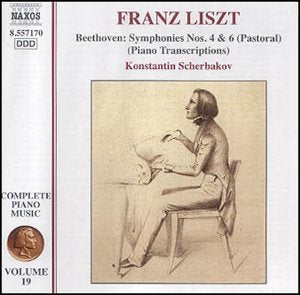
Please Note Not All Our New Items Are Shrink Wrapped.All items shipped within 3 working days of payment.Franz Liszt (1811-1886)Piano Transcriptions of Beethovens Symphonies Nos. 4 & 6 (S464/R128)Symphony No.4 in B flat major, Op.60Symphony No.6 in F major, Op.68 (Pastoral)The first piece that Liszt played in his first concert was the three last movements of Beethovens Pastoral Symphony, 'Scherzo, orage et Finale'. The transcription of this great and complicated composition for the pianoforte was a task as daring as it was difficult, if it was not to be only a brilliant concert piece, but much more than that, a work without arbitrary additions or omissions reproduced with artistic fidelity and scrupulousness according to its spirit and its innermost being, and only an artist like Liszt, who, with an unbounded reverence for Beethoven, has rare gifts in understanding the great German master, only such an artist was able and dared venture on so dangerous an undertaking.Heinrich Adami, Allgemeiner Theaterzeitung. 21.11.1839 Born at Raiding, in Hungary, in 1811, the son of Adam Liszt, a steward in the service of Haydns former patrons, the Esterházy Princes, Franz Liszt had early encouragement from members of the Hungarian nobility, allowing him in 1822 to move to Vienna, for lessons with Czerny and a famous meeting with Beethoven.From there he moved to Paris, where Cherubini refused him admission to the Conservatoire.Nevertheless he was able to impress audiences by his performance, now supported by the Erard family, piano manufacturers whose wares he was able to advertise in the concert tours on which he embarked.In 1827 Adam Liszt died, and Franz Liszt was now joined again by his mother in Paris, while using his time to teach, to read and benefit from the intellectual society with which he came into contact.His interest in virtuoso performance was renewed when he heard the great violinist Paganini, whose technical accomplishments he now set out to emulate. The years that followed brought a series of compositions, including transcriptions of songs and operatic fantasies, part of the stock-in-trade of a virtuoso.Liszts relationship with a married woman, the Comtesse Marie dAgoult, led to his departure from Paris for years of travel abroad, first to Switzerland, then back to Paris, before leaving for Italy, Vienna and Hungary.By 1844 his relationship with his mistress, the mother of his three children, was at an end, but his concert activities continued until 1847, the year in which his association began with Carolyne zu Sayn-Wittgenstein, a Polish heiress, the estranged wife of a Russian prince.The following year he settled with her in Weimar, the city of Goethe, turning his attention now to the development of a newer form of orchestral music, the symphonic poem, and, as always, to the revision and publication of earlier compositions. It was in 1861, at the age of fifty, that Liszt moved to Rome, following Princess Carolyne, who had settled there a year earlier.Divorce and annulment seemed to have opened the
Piano transcription of Beethoven's Symphony no. 6 (Pastoral) - Liszt
Piano transcription of Beethoven's Symphony no. 4 - Liszt
Details
- Genre: Classical
- Product Type: AUDIO CD
- Barcode: 747313217021
Are all of your items new?
Yes! All of our items are brand new and unused, however not all UK items come factory sealed.
Delivery and Returns
Dispatch Information: Dispatch times vary by item and items are only dispatched on UK working days – not weekends or UK Bank Holidays. Items marked "Dispatched Same Day" will be dispatched on the day of purchase if bought before 2pm GMT. "Dispatched Same Day" items bought after 2pm GMT or on a non-working day will be dispatched on the next working day. For all other items the dispatch timeframe is clearly labelled on the product page.
Delivery Information: We aim to deliver your order as quickly and efficiently as possible. All UK orders are dispatched using Royal Mail 48 Tracked service and the standard delivery times are 2-3 business days. Please note that delivery times for overseas orders will vary depending on your location and the shipping option you choose during checkout.
Shipping Costs: We offer free delivery on all UK orders and free worldwide delivery on orders over £15.
Tracking Your Order: All UK orders are tracked. Once your order is dispatched, you will receive a tracking number via email. You can use this tracking number to monitor the progress of your delivery on the Royal Mail Track and Trace website.
Returns and Exchanges: We want you to be completely satisfied with your purchase. If for any reason you are not happy with your order, you may return it within 28 days of the item being dispatched for a refund or exchange. Please note the following guidelines:
- Items must be returned in their original condition and packaging – items that have been opened or had shrink wrap removed are not eligible for return or refund.
- Make sure to include your order number in the returned package.
How to Initiate a Return: To initiate a return or exchange, please contact our customer service team. The team is available to assist you with any questions or concerns you may have about the process.
Refund Processing: Refunds will be processed as soon as we receive your item back into our warehouse. Replacements are subject to availability and if a replacement is not available, a refund will be issued.
If you have any further questions or need assistance, please don't hesitate to contact our customer service team or check out our FAQ’s. We're here to help ensure your shopping experience is enjoyable and hassle-free. Thank you for choosing Chalkys!
Delivery Information: We aim to deliver your order as quickly and efficiently as possible. All UK orders are dispatched using Royal Mail 48 Tracked service and the standard delivery times are 2-3 business days. Please note that delivery times for overseas orders will vary depending on your location and the shipping option you choose during checkout.
Shipping Costs: We offer free delivery on all UK orders and free worldwide delivery on orders over £15.
Tracking Your Order: All UK orders are tracked. Once your order is dispatched, you will receive a tracking number via email. You can use this tracking number to monitor the progress of your delivery on the Royal Mail Track and Trace website.
Returns and Exchanges: We want you to be completely satisfied with your purchase. If for any reason you are not happy with your order, you may return it within 28 days of the item being dispatched for a refund or exchange. Please note the following guidelines:
- Items must be returned in their original condition and packaging – items that have been opened or had shrink wrap removed are not eligible for return or refund.
- Make sure to include your order number in the returned package.
How to Initiate a Return: To initiate a return or exchange, please contact our customer service team. The team is available to assist you with any questions or concerns you may have about the process.
Refund Processing: Refunds will be processed as soon as we receive your item back into our warehouse. Replacements are subject to availability and if a replacement is not available, a refund will be issued.
If you have any further questions or need assistance, please don't hesitate to contact our customer service team or check out our FAQ’s. We're here to help ensure your shopping experience is enjoyable and hassle-free. Thank you for choosing Chalkys!