

Description
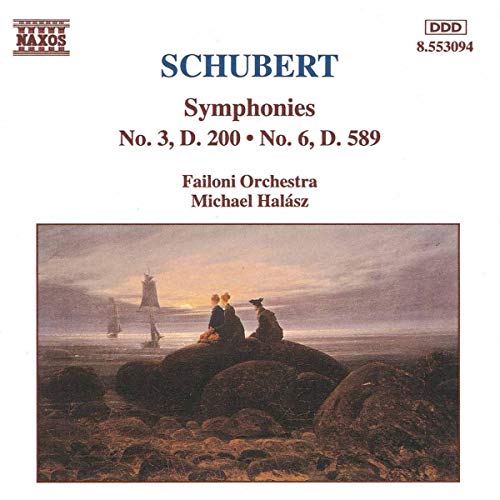
Please Note Not All Our New Items Are Shrink Wrapped.All items shipped within 3 working days of payment.Franz Schubert (1797 -1828) Symphony No.3 in D Major, D. 200 Symphony No.6 in C Major, D. 589 Franz Schubert was born in Vienna in 1797, the son of a schoolmaster who had settled in the city some fourteen years before. He showed early musical ability, exercised in the family quartet with his father and older brothers, and in 1808 was successful in winning a place as a chorister in the Imperial Chapel, enabling him to continue his general education at the Staatskonvikt, a school of the highest prestige. It was here that he was exposed to a wider musical world and began to compose. At the Konvikt he could profit from the presence of the old Kapellmeister Salieri and broaden his practical experience by playing the violin in the student orchestra, which he sometimes led. His voice broke in 1812 and he rejected the offer of a scholarship for further study, instead entering the Normal School of St. Anna to train as an elementary teacher. In this capacity he joined his father in the school-room in 1815. The following year he was unsuccessful in an application for a position as music teacher at the Normal School in Laibach (Ljubljana) but left home to lodge instead with his friend Franz von Schober. The remaining years of Schubert's life were spent predominantly in Vienna, more often than not in the company of friends. There were occasions when he returned briefly to teaching at his father's school, but as a composer he proved increasingly prolific, particularly in the writing of songs, welcomed among his own circle and winning him gradually a wider reputation. Some of his songs proved immediately successful, particularly through the advocacy of his friend, the singer Michael Vogl, and there were commissions for the theatre and publication of piano pieces and songs well suited to the new domestic market. His last years, however, were clouded by illness. A syphilitic infection, in those days incurable, took its intermittent course, and he died in November 1828, twenty months after the death of Beethoven. While the latter had from the first enjoyed distinguished patronage and had had an early career as a virtuoso pianist, Schubert had occupied a different position, part, rather, of the society of Biedermeier Vienna. Lacking the esteem and patronage from which Beethoven had profited, Schubert published relatively little and consequently left a great deal of music to be rediscovered posthumously. His orchestral writing was clearly influenced by the repertoire of the Staatskonvikt orchestra, which included symphonies by Mozart and Haydn, as well as the earlier Beethoven symphonies. The family quartet tackled four-part versions of Haydn symphonies and the ensemble grew so that by 1815, under the leadership of the violinist Otto Hatwig, it could muster some twenty string players, as well as double woodwind and percussion, providing an orchestra for which Schubert, who played viola, wrote his earlier symphonies and overtures. Alternative numbering for Schubert's
Adagio Maestoso - Allegro Con Brio
Allegretto
Menuetto: Vivace
Presto Vivace
Adagio - Allegro
Andante
Presto
Allegro Moderato
Details
- Genre: Classical
- Product Type: AUDIO CD
- Barcode: 730099409421
Delivery and Returns
Dispatch Information: Dispatch times vary by item and items are only dispatched on UK working days – not weekends or UK Bank Holidays. Items marked "Dispatched Same Day" will be dispatched on the day of purchase if bought before 2pm GMT. "Dispatched Same Day" items bought after 2pm GMT or on a non-working day will be dispatched on the next working day. For all other items the dispatch timeframe is clearly labelled on the product page.
Delivery Information: We aim to deliver your order as quickly and efficiently as possible. All UK orders are dispatched using Royal Mail 48 Tracked service and the standard delivery times are 2-3 business days. Please note that delivery times for overseas orders will vary depending on your location and the shipping option you choose during checkout.
Shipping Costs: We offer free delivery on all UK orders and free worldwide delivery on orders over £15.
Tracking Your Order: All UK orders are tracked. Once your order is dispatched, you will receive a tracking number via email. You can use this tracking number to monitor the progress of your delivery on the Royal Mail Track and Trace website.
Returns and Exchanges: We want you to be completely satisfied with your purchase. If for any reason you are not happy with your order, you may return it within 28 days of the item being dispatched for a refund or exchange. Please note the following guidelines:
- Items must be returned in their original condition and packaging – items that have been opened or had shrink wrap removed are not eligible for return or refund.
- Make sure to include your order number in the returned package.
How to Initiate a Return: To initiate a return or exchange, please contact our customer service team. The team is available to assist you with any questions or concerns you may have about the process.
Refund Processing: Refunds will be processed as soon as we receive your item back into our warehouse. Replacements are subject to availability and if a replacement is not available, a refund will be issued.
If you have any further questions or need assistance, please don't hesitate to contact our customer service team or check out our FAQ’s. We're here to help ensure your shopping experience is enjoyable and hassle-free. Thank you for choosing Chalkys!
Delivery Information: We aim to deliver your order as quickly and efficiently as possible. All UK orders are dispatched using Royal Mail 48 Tracked service and the standard delivery times are 2-3 business days. Please note that delivery times for overseas orders will vary depending on your location and the shipping option you choose during checkout.
Shipping Costs: We offer free delivery on all UK orders and free worldwide delivery on orders over £15.
Tracking Your Order: All UK orders are tracked. Once your order is dispatched, you will receive a tracking number via email. You can use this tracking number to monitor the progress of your delivery on the Royal Mail Track and Trace website.
Returns and Exchanges: We want you to be completely satisfied with your purchase. If for any reason you are not happy with your order, you may return it within 28 days of the item being dispatched for a refund or exchange. Please note the following guidelines:
- Items must be returned in their original condition and packaging – items that have been opened or had shrink wrap removed are not eligible for return or refund.
- Make sure to include your order number in the returned package.
How to Initiate a Return: To initiate a return or exchange, please contact our customer service team. The team is available to assist you with any questions or concerns you may have about the process.
Refund Processing: Refunds will be processed as soon as we receive your item back into our warehouse. Replacements are subject to availability and if a replacement is not available, a refund will be issued.
If you have any further questions or need assistance, please don't hesitate to contact our customer service team or check out our FAQ’s. We're here to help ensure your shopping experience is enjoyable and hassle-free. Thank you for choosing Chalkys!