

Description
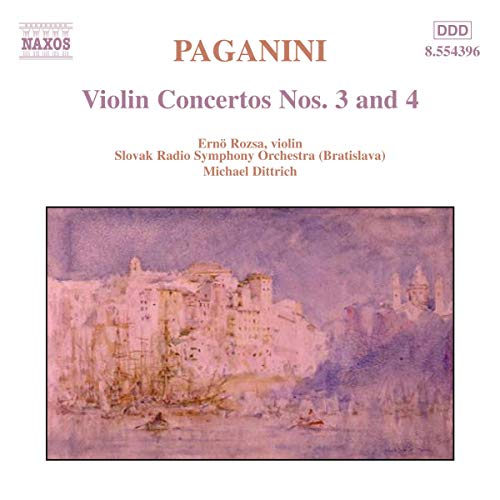
Please Note Not All Our New Items Are Shrink Wrapped.All items shipped within 3 working days of payment.Nicol?? Paganini(1782-1840) Violin Concertos Nos.3 and 4Paganini's popular reputation rested always on his phenomenal techniqueas a violinist, coupled with a showman's ability to dominate an audience and tostupefy those who heard him by astonishing feats of virtuosity. His playingserved as an inspiration to other performers in the nineteenth century,suggesting to Chopin, in Warsaw, the piano Etudes, and to Liszt thematerial of the Paganini studies that he wrote in 1838. The very appearance ofPaganini impressed people. His gaunt, aquiline features, his suggestion ofhunched shoulders and his sombre clothing gave rise to legends of associationwith the Devil, the alleged source of his power. These stories were denied byPaganini himself, who, with characteristic understanding of the value of publicrelations in a more credulous age, told of an angelic visitation to his mother,in a dream, foretelling his birth and genius.Paganini was born in Genoa in 1782 and was taught the violin first byhis father, an amateur, and then by a violinist in the theatre orchestra and bythe better known player Giacomo Costa, under whose tuition he gave a publicperformance in 1794. The following year he played to the violinist and teacherAlessandro Rollo in Parma, and on the latter's suggestion studied compositionthere under Paer. After a return to Genoa and removal during the Napoleonicinvasion, he settled in 1801 in Lucca, where, after 1805, he became violinistto the new ruler, Princess Elsa Baciocchi, sister of Napoleon. At the end of1809 he left to travel, during the next eighteen years, throughout Italy,winning a very considerable popular reputation. It was not until 1828 that hemade his first concert tour abroad, visiting Vienna, Prague and then the major citiesof Germany, followed by Paris and London in 1831. His international career as avirtuoso ended in 1834, when, after an unsatisfactory tour of England, hereturned again to Italy, to Parma. A return to the concert-hall in Nice andthen, to considerable acclaim, in Marseilles, was followed by an unsuccessfulbusiness venture in Paris, the Casino Paganini, which was intended to providefacilities equally for gambling and for music. With increasing ill health, heretired to Nice, where he died in 1840.Many of Paganinis compositions for the violin remained unpublished inhis lifetime, part of his stock-in-trade, to which he had exclusive access. Hewrote a quantity of music for violin and orchestra, including six concertos.The Violin Concerto No. 3 in E major was written in 1826, a time of somedifficulty. In 1824 he had started a liaison with a young singer, AdrianaBianchi, who bore him a son, Achille, the following year, a child to whomPaganini became very attached. Adriana Bianchi, however, was a troublesomepartner, jealous and unpredictable in her behaviour, while Paganini, twice herage, was increasingly subject to illness. In 1826 indisposition forced him torest in Naples, where he wrote two concertos, the present work a
Concerto No.3 in E major for violin and orchestra
Concerto No.4 in D minor for violin and orchestra
Details
- Genre: Classical
- Product Type: AUDIO CD
- Barcode: 636943439623
Delivery and Returns
Dispatch Information: Dispatch times vary by item and items are only dispatched on UK working days – not weekends or UK Bank Holidays. Items marked "Dispatched Same Day" will be dispatched on the day of purchase if bought before 2pm GMT. "Dispatched Same Day" items bought after 2pm GMT or on a non-working day will be dispatched on the next working day. For all other items the dispatch timeframe is clearly labelled on the product page.
Delivery Information: We aim to deliver your order as quickly and efficiently as possible. All UK orders are dispatched using Royal Mail 48 Tracked service and the standard delivery times are 2-3 business days. Please note that delivery times for overseas orders will vary depending on your location and the shipping option you choose during checkout.
Shipping Costs: We offer free delivery on all UK orders and free worldwide delivery on orders over £15.
Tracking Your Order: All UK orders are tracked. Once your order is dispatched, you will receive a tracking number via email. You can use this tracking number to monitor the progress of your delivery on the Royal Mail Track and Trace website.
Returns and Exchanges: We want you to be completely satisfied with your purchase. If for any reason you are not happy with your order, you may return it within 28 days of the item being dispatched for a refund or exchange. Please note the following guidelines:
- Items must be returned in their original condition and packaging – items that have been opened or had shrink wrap removed are not eligible for return or refund.
- Make sure to include your order number in the returned package.
How to Initiate a Return: To initiate a return or exchange, please contact our customer service team. The team is available to assist you with any questions or concerns you may have about the process.
Refund Processing: Refunds will be processed as soon as we receive your item back into our warehouse. Replacements are subject to availability and if a replacement is not available, a refund will be issued.
If you have any further questions or need assistance, please don't hesitate to contact our customer service team or check out our FAQ’s. We're here to help ensure your shopping experience is enjoyable and hassle-free. Thank you for choosing Chalkys!
Delivery Information: We aim to deliver your order as quickly and efficiently as possible. All UK orders are dispatched using Royal Mail 48 Tracked service and the standard delivery times are 2-3 business days. Please note that delivery times for overseas orders will vary depending on your location and the shipping option you choose during checkout.
Shipping Costs: We offer free delivery on all UK orders and free worldwide delivery on orders over £15.
Tracking Your Order: All UK orders are tracked. Once your order is dispatched, you will receive a tracking number via email. You can use this tracking number to monitor the progress of your delivery on the Royal Mail Track and Trace website.
Returns and Exchanges: We want you to be completely satisfied with your purchase. If for any reason you are not happy with your order, you may return it within 28 days of the item being dispatched for a refund or exchange. Please note the following guidelines:
- Items must be returned in their original condition and packaging – items that have been opened or had shrink wrap removed are not eligible for return or refund.
- Make sure to include your order number in the returned package.
How to Initiate a Return: To initiate a return or exchange, please contact our customer service team. The team is available to assist you with any questions or concerns you may have about the process.
Refund Processing: Refunds will be processed as soon as we receive your item back into our warehouse. Replacements are subject to availability and if a replacement is not available, a refund will be issued.
If you have any further questions or need assistance, please don't hesitate to contact our customer service team or check out our FAQ’s. We're here to help ensure your shopping experience is enjoyable and hassle-free. Thank you for choosing Chalkys!