

Description
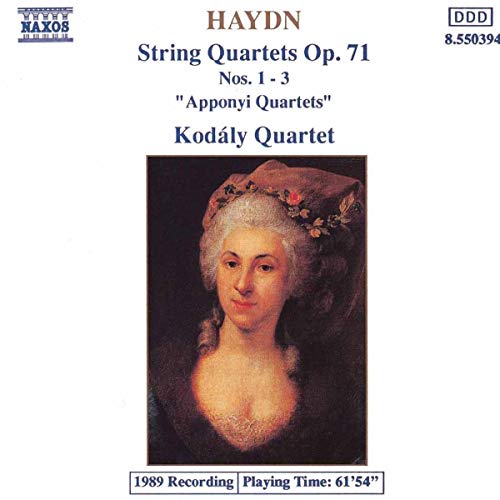
Please Note Not All Our New Items Are Shrink Wrapped.All items shipped within 3 working days of payment.Joseph Haydn (1732-1809) Apponyi Quartets, Nos. 1 - 3 (Op. 71,Nos. 1 - 3)Joseph Haydn was born in the village ofRohrau in 1732, the son of a wheelwright. Trained at the choir-school of St.Stephen's Cathedral in Vienna, he spent some years earning a living as best hecould from teaching and playing the violin or keyboard, and was able to learnfrom the old musician Porpora, whose assistant he became. Haydn's firstappointment was in 1759 as Kapellmeister to a Bohemian nobleman, Count vonMorzin. This was followed in 1761 by employment as Vice-Kapellmeister to one ofthe richest men in the Empire, Prince Paul Anton Esterhazy, succeeded on hisdeath in 1762 by his brother Prince Nikolaus. On the death in 1766 of theelderly and somewhat obstructive Kapellmeister, Gregor Werner, Haydn succeededto his position, to remain in the same employment for the rest of his life.On the completion of the magnificentpalace at Esterhaza, in the Hungarian plains, under the new Prince, Haydnassumed command of an increased musical establishment. Here he hadresponsibility for the musical activities of the palace, which included theprovision and direction of instrumental music, opera and theatre music, andmusic for the church. For his patron he provided a quantity of chamber music ofall kinds, particularly for the Prince's own peculiar instrument, the baryton,a bowed string instrument with sympathetic strings that could also be plucked.On the death of Prince Nikolaus in 1790,Haydn was able to accept an invitation to visit London, where he provided musicfor the concert season organized by the violinist-impresario Salomon. A secondsuccessful visit to London in 1794 and 1795 was followed by a return to dutywith the Esterhazy family, the new head of which had settled principally at thefamily property in Eisenstadt, where Haydn had started his career. Much of theyear, however, was to be spent in Vienna, where Haydn passed his final years,dying in 1809, as the French armies of Napoleon approached the city yet again. Haydn lived during the period of the 18thcentury that saw the development of instrumental music from the age of Bach andHandel to the era of the classical sonata, with its tripartite form, the basisof much instrumental composition. The string quartet itself, which came torepresent classical music in its purest form, grew from a genre that wasrelatively insignificant, at least in its nomenclature, the Divertimento, intomusic of greater weight, substance and complexity, although Haydn, like anygreat master, knew well how to conceal the technical means by which he achievedhis ends. The exact number of string quartets that Haydn wrote is not known,although he listed some 83. The earlier of these, often under the titleDivertimento, proclaim their origin and purpose. The last quartet, Opus 103,started in 1803, remained unfinished.The so-called Apponyi Quartets werewritten in 1793 and dedicated to a nobleman, Count Anton Georg Apponyi, who wasa member of the circle dominated by
Str Qt in B flat, Op.71, No.1, Hob.III: 69: Allegro
Str Qt in B flat, Op.71, No.1, Hob.III: 69: Adagio
Str Qt in B flat, Op.71, No.1, Hob.III: 69: Menuetto: Allegretto
Str Qt in B flat, Op.71, No.1, Hob.III: 69: (Finale): Vivace
Str Qt in D, Op.71, No.2, Hob.III: 70: Adagio-Allegro
Str Qt in D, Op.71, No.2, Hob.III: 70: Adagio (Cantabile)
Str Qt in D, Op.71, No.2, Hob.III: 70: Menuetto: Allegretto
Str Qt in D, Op.71, No.2, Hob.III: 70: Finale: Allegretto
Str Qt in E flat, Op.71, No.3, Hob.III: 71: Vivace
Str Qt in E flat, Op.71, No.3, Hob.III: 71: Andante Con Moto
Str Qt in E flat, Op.71, No.3, Hob.III: 71: Menuetto
Str Qt in E flat, Op.71, No.3, Hob.III: 71: Finale: Vivace
Details
- Genre: Classical
- Product Type: AUDIO CD
- Barcode: 730099539425
Delivery and Returns
Dispatch Information: Dispatch times vary by item and items are only dispatched on UK working days – not weekends or UK Bank Holidays. Items marked "Dispatched Same Day" will be dispatched on the day of purchase if bought before 2pm GMT. "Dispatched Same Day" items bought after 2pm GMT or on a non-working day will be dispatched on the next working day. For all other items the dispatch timeframe is clearly labelled on the product page.
Delivery Information: We aim to deliver your order as quickly and efficiently as possible. All UK orders are dispatched using Royal Mail 48 Tracked service and the standard delivery times are 2-3 business days. Please note that delivery times for overseas orders will vary depending on your location and the shipping option you choose during checkout.
Shipping Costs: We offer free delivery on all UK orders and free worldwide delivery on orders over £15.
Tracking Your Order: All UK orders are tracked. Once your order is dispatched, you will receive a tracking number via email. You can use this tracking number to monitor the progress of your delivery on the Royal Mail Track and Trace website.
Returns and Exchanges: We want you to be completely satisfied with your purchase. If for any reason you are not happy with your order, you may return it within 28 days of the item being dispatched for a refund or exchange. Please note the following guidelines:
- Items must be returned in their original condition and packaging – items that have been opened or had shrink wrap removed are not eligible for return or refund.
- Make sure to include your order number in the returned package.
How to Initiate a Return: To initiate a return or exchange, please contact our customer service team. The team is available to assist you with any questions or concerns you may have about the process.
Refund Processing: Refunds will be processed as soon as we receive your item back into our warehouse. Replacements are subject to availability and if a replacement is not available, a refund will be issued.
If you have any further questions or need assistance, please don't hesitate to contact our customer service team or check out our FAQ’s. We're here to help ensure your shopping experience is enjoyable and hassle-free. Thank you for choosing Chalkys!
Delivery Information: We aim to deliver your order as quickly and efficiently as possible. All UK orders are dispatched using Royal Mail 48 Tracked service and the standard delivery times are 2-3 business days. Please note that delivery times for overseas orders will vary depending on your location and the shipping option you choose during checkout.
Shipping Costs: We offer free delivery on all UK orders and free worldwide delivery on orders over £15.
Tracking Your Order: All UK orders are tracked. Once your order is dispatched, you will receive a tracking number via email. You can use this tracking number to monitor the progress of your delivery on the Royal Mail Track and Trace website.
Returns and Exchanges: We want you to be completely satisfied with your purchase. If for any reason you are not happy with your order, you may return it within 28 days of the item being dispatched for a refund or exchange. Please note the following guidelines:
- Items must be returned in their original condition and packaging – items that have been opened or had shrink wrap removed are not eligible for return or refund.
- Make sure to include your order number in the returned package.
How to Initiate a Return: To initiate a return or exchange, please contact our customer service team. The team is available to assist you with any questions or concerns you may have about the process.
Refund Processing: Refunds will be processed as soon as we receive your item back into our warehouse. Replacements are subject to availability and if a replacement is not available, a refund will be issued.
If you have any further questions or need assistance, please don't hesitate to contact our customer service team or check out our FAQ’s. We're here to help ensure your shopping experience is enjoyable and hassle-free. Thank you for choosing Chalkys!