

Description
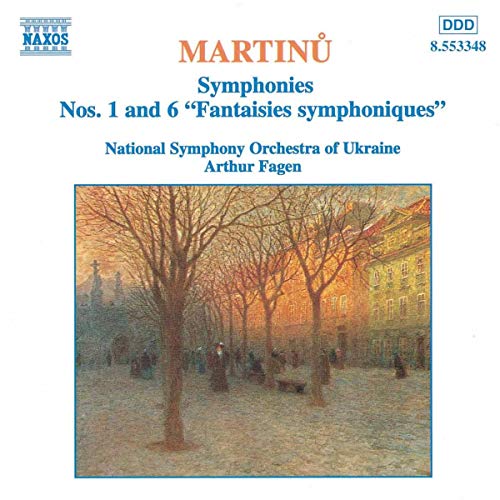
Please Note Not All Our New Items Are Shrink Wrapped.All items shipped within 3 working days of payment.Bohuslav Martinu (1890-1959) Symphony No.1 Symphony No.6 (Fantaisies symphoniques) The Czech composer Bohuslav Martinu was born in 1890 at Policka in Bohemia in a bell-tower. where his father, a shoe-maker by trade, was employed as watchman. In his childhood he learned the violin from a local tailor and made a local reputation for himself, giving his first public concert in his home-town in 1905. At the same time he concentrated attention on composition, although without proper tuition and lacking even the necessary manuscript-paper for the purpose. In 1906 he became a violin student at the Prague Conservatory, but four years later, after relegation for one year to the Organ School, he was expelled. His principal interest, in fact, continued to centre on composition, and he pursued this aim during the war, which he spent as a teacher in Policka. In 1918 he joined the Czech Philharmonic Orchestra as a violinist and his ballet Istar, completed in 1922, was performed in 1924. There had been a brief period of instruction in composition from Josef Suk at the Conservatory, soon abandoned and in 1923, assisted by a scholarship, he moved to Paris to become a pupil of Albert Roussel. In the following years Martinu's music began to gain a hearing, particularly through Talich in Czechoslovakia, Paul Sacher and Ernest Ansermet in Switzerland, Henry Wood in England, Munch in France and Koussevitzky in the United States. By 1931 he had established himself well enough to marry a young dressmaker. Charlotte Quennehen, although he never earned enough to allow even reasonable comfort. The first performance of his Concerto Grosso planned by Talich in 1938 was postponed with the invasion of Czechoslovakia that year and in June 1940 he and his wife hurriedly fled from Paris, four days before the Germany armies marched into the city. With considerable difficulty they made their way to Portugal and thence to Bermuda, reaching New York at the end of March 1941. In the United States Martinu eventually received commissions from the Koussevitzky Foundation, for which he wrote his First Symphony. This was followed by further symphonies and concertos, including a violin concerto commissioned by Mischa Elman, while in 1943 his Memorial Stanzas, dedicated to Albert Einstein, were played by the famous scientist with the pianist Robert Casadesus. After the war he planned to return to Prague, where he had been offered the position of professor of composition at the Conservatory, but was prevented from doing so by the accession to power of the Communist Party. In 1948 he became professor of composition at Princeton University, returning to Europe in 1953. He lived in Nice until 1955, when he moved to Philadelphia to teach at the Curtis Institute. The following year he returned to Europe to teach at the American Academy in Rome. He spent his final years in Switzerland, where he died of cancer in 1959. Martinu was an enormously prolific composer, who seemed often enough careless of
Symphony No. 1: Moderato
Symphony No. 1: Allegro - Poco moderato - Allegro come prima
Symphony No. 1: Largo
Symphony No. 1: Allegro non troppo
Symphony No.6 'Fantaisies symphoniques': Lento - Allegro - Lento
Symphony No.6 'Fantaisies symphoniques': Poco allegro
Symphony No.6 'Fantaisies symphoniques': Lento - Poco vivo adagio - Andante - Moderato - Allegro Viv
Details
- Genre: Classical
- Product Type: AUDIO CD
- Barcode: 730099434829
Delivery and Returns
Dispatch Information: Dispatch times vary by item and items are only dispatched on UK working days – not weekends or UK Bank Holidays. Items marked "Dispatched Same Day" will be dispatched on the day of purchase if bought before 2pm GMT. "Dispatched Same Day" items bought after 2pm GMT or on a non-working day will be dispatched on the next working day. For all other items the dispatch timeframe is clearly labelled on the product page.
Delivery Information: We aim to deliver your order as quickly and efficiently as possible. All UK orders are dispatched using Royal Mail 48 Tracked service and the standard delivery times are 2-3 business days. Please note that delivery times for overseas orders will vary depending on your location and the shipping option you choose during checkout.
Shipping Costs: We offer free delivery on all UK orders and free worldwide delivery on orders over £15.
Tracking Your Order: All UK orders are tracked. Once your order is dispatched, you will receive a tracking number via email. You can use this tracking number to monitor the progress of your delivery on the Royal Mail Track and Trace website.
Returns and Exchanges: We want you to be completely satisfied with your purchase. If for any reason you are not happy with your order, you may return it within 28 days of the item being dispatched for a refund or exchange. Please note the following guidelines:
- Items must be returned in their original condition and packaging – items that have been opened or had shrink wrap removed are not eligible for return or refund.
- Make sure to include your order number in the returned package.
How to Initiate a Return: To initiate a return or exchange, please contact our customer service team. The team is available to assist you with any questions or concerns you may have about the process.
Refund Processing: Refunds will be processed as soon as we receive your item back into our warehouse. Replacements are subject to availability and if a replacement is not available, a refund will be issued.
If you have any further questions or need assistance, please don't hesitate to contact our customer service team or check out our FAQ’s. We're here to help ensure your shopping experience is enjoyable and hassle-free. Thank you for choosing Chalkys!
Delivery Information: We aim to deliver your order as quickly and efficiently as possible. All UK orders are dispatched using Royal Mail 48 Tracked service and the standard delivery times are 2-3 business days. Please note that delivery times for overseas orders will vary depending on your location and the shipping option you choose during checkout.
Shipping Costs: We offer free delivery on all UK orders and free worldwide delivery on orders over £15.
Tracking Your Order: All UK orders are tracked. Once your order is dispatched, you will receive a tracking number via email. You can use this tracking number to monitor the progress of your delivery on the Royal Mail Track and Trace website.
Returns and Exchanges: We want you to be completely satisfied with your purchase. If for any reason you are not happy with your order, you may return it within 28 days of the item being dispatched for a refund or exchange. Please note the following guidelines:
- Items must be returned in their original condition and packaging – items that have been opened or had shrink wrap removed are not eligible for return or refund.
- Make sure to include your order number in the returned package.
How to Initiate a Return: To initiate a return or exchange, please contact our customer service team. The team is available to assist you with any questions or concerns you may have about the process.
Refund Processing: Refunds will be processed as soon as we receive your item back into our warehouse. Replacements are subject to availability and if a replacement is not available, a refund will be issued.
If you have any further questions or need assistance, please don't hesitate to contact our customer service team or check out our FAQ’s. We're here to help ensure your shopping experience is enjoyable and hassle-free. Thank you for choosing Chalkys!