

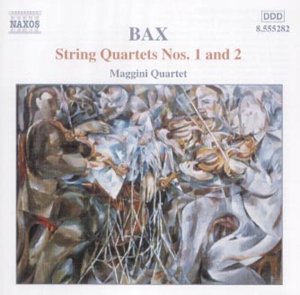
Description
Please Note Not All Our New Items Are Shrink Wrapped.All items shipped within 3 working days of payment.Sir Arnold Bax (1883-1953)String Quartets Nos. 1 and 2Arnold Baxwas the eldest son of a well-off non-conformist family from south London, whose early talentwas encouraged by his mother, as was that of his brother, the writer andplaywright Clifford Bax. Bax was born in Streatham, then still Surrey, but his most impressionable years were spent inHampstead, then semi-rural, where in 1896 his father bought an imposingmansion, set in three and a half acres.Bax studiedfrom 1900 to 1905 at the Royal Academy of Music with the composer Frederick Corderand the piano teacher Tobias Matthay. Leaving in the summer of 1905, he wasable, thanks to a private income, to develop his musical career as he pleased. Escapingthe constraints of parental influence, he adopted a semi-bohemian lifestyle,travelling widely, to Dresden, and subsequently Russia, and, best of all, tothe west coast of Ireland, where, 'lorded by the Atlantic', as he put it, andunder the influence of the early poetry of Yeats, he discovered the village of Glencolumcillein Donegal, to which, until the First World War, he constantly returned.Imbibingall things Irish, Bax wrote poetry, short stories and Synge-like plays,published under the pseudonym of Dermot O'Byrne. Married in 1911, he set uphouse in a Dublin suburb, and moved in Dublin literary andnationalist circles; his friends and acquaintances included the poet and writerPadraic Colum, founder of the IrishReview, and Padraig Pearse, champion of the Irish language, who was executedafter the Easter Rising in 1916.It is forhis orchestral music that Bax is now more widely known, in particular hisatmospheric tone-poems, the most famous of which is Tintagel, written in 1917 and orchestrated by 1919. Between thewars came seven symphonies, which enhanced his reputation at the time, andthere was also much piano music, as well as instrumental sonatas and manysongs. There is, however, also a large corpus of chamber music and he publishedthree string quartets, a piano trio, a piano quartet, a piano quintet and manyworks for larger ensemble including a nonet.Two earlystring quartets survive from Bax's student years at the Royal Academy,followed soon after by a piano trio, though with viola replacing the usualcello, and then an extended string quintet. All these early chamber works herepudiated, although they remain worthy of revival. His first major work in themedium was his large-scale Piano Quintet,completed early in 1915, followed in 1916 by his Elegiac Trio for flute, viola and harp.When Baxcame to write his first mature string quartet the war was in its last year,though curiously the quartet is a serene work and bears few overt influence ofthe times in which it was written. It is dated 1918 and was first performed bythe Philharmonic Quartet at London'sAeolian Hall on 7th June 1918. The published score is dedicated to Sir EdwardElgar who, in response to Bax's letter of 3rd March 1921 offering thededication, replied that he 'liked the look of it'. Bax ha
Allegretto Semplice
Lento E Molto Expressivo
Rondo: Allegro Vivace
Allegro
Lento, Molto Espressivo
Allegro Vivace
Details
- Genre: Classical
- Product Type: AUDIO CD
- Barcode: 747313528226
Delivery and Returns
Dispatch Information: Dispatch times vary by item and items are only dispatched on UK working days – not weekends or UK Bank Holidays. Items marked "Dispatched Same Day" will be dispatched on the day of purchase if bought before 2pm GMT. "Dispatched Same Day" items bought after 2pm GMT or on a non-working day will be dispatched on the next working day. For all other items the dispatch timeframe is clearly labelled on the product page.
Delivery Information: We aim to deliver your order as quickly and efficiently as possible. All UK orders are dispatched using Royal Mail 48 Tracked service and the standard delivery times are 2-3 business days. Please note that delivery times for overseas orders will vary depending on your location and the shipping option you choose during checkout.
Shipping Costs: We offer free delivery on all UK orders and free worldwide delivery on orders over £15.
Tracking Your Order: All UK orders are tracked. Once your order is dispatched, you will receive a tracking number via email. You can use this tracking number to monitor the progress of your delivery on the Royal Mail Track and Trace website.
Returns and Exchanges: We want you to be completely satisfied with your purchase. If for any reason you are not happy with your order, you may return it within 28 days of the item being dispatched for a refund or exchange. Please note the following guidelines:
- Items must be returned in their original condition and packaging – items that have been opened or had shrink wrap removed are not eligible for return or refund.
- Make sure to include your order number in the returned package.
How to Initiate a Return: To initiate a return or exchange, please contact our customer service team. The team is available to assist you with any questions or concerns you may have about the process.
Refund Processing: Refunds will be processed as soon as we receive your item back into our warehouse. Replacements are subject to availability and if a replacement is not available, a refund will be issued.
If you have any further questions or need assistance, please don't hesitate to contact our customer service team or check out our FAQ’s. We're here to help ensure your shopping experience is enjoyable and hassle-free. Thank you for choosing Chalkys!
Delivery Information: We aim to deliver your order as quickly and efficiently as possible. All UK orders are dispatched using Royal Mail 48 Tracked service and the standard delivery times are 2-3 business days. Please note that delivery times for overseas orders will vary depending on your location and the shipping option you choose during checkout.
Shipping Costs: We offer free delivery on all UK orders and free worldwide delivery on orders over £15.
Tracking Your Order: All UK orders are tracked. Once your order is dispatched, you will receive a tracking number via email. You can use this tracking number to monitor the progress of your delivery on the Royal Mail Track and Trace website.
Returns and Exchanges: We want you to be completely satisfied with your purchase. If for any reason you are not happy with your order, you may return it within 28 days of the item being dispatched for a refund or exchange. Please note the following guidelines:
- Items must be returned in their original condition and packaging – items that have been opened or had shrink wrap removed are not eligible for return or refund.
- Make sure to include your order number in the returned package.
How to Initiate a Return: To initiate a return or exchange, please contact our customer service team. The team is available to assist you with any questions or concerns you may have about the process.
Refund Processing: Refunds will be processed as soon as we receive your item back into our warehouse. Replacements are subject to availability and if a replacement is not available, a refund will be issued.
If you have any further questions or need assistance, please don't hesitate to contact our customer service team or check out our FAQ’s. We're here to help ensure your shopping experience is enjoyable and hassle-free. Thank you for choosing Chalkys!