

Description
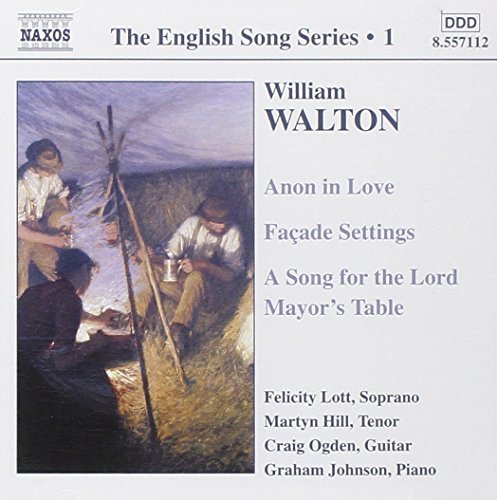
Please Note Not All Our New Items Are Shrink Wrapped.All items shipped within 3 working days of payment.William Walton (1902-1983)Anon in Love Façade Settings A Song for the Lord Mayors TableWilliam Walton occupies his own position in English music of the twentieth century, chronologically between the generation of Gustav Holst and Vaughan Williams and that of Benjamin Britten. Born in Oldham in 1902, the son of a local singing teacher and choirmaster, he became a chorister at Christ Church, Oxford, and followed this with admission to the university at the early age of sixteen, with support from the college. His Oxford career brought success in music but failure in the necessary academic tests to allow him a degree. At the same time his friendship with Sacheverell Sitwell led to his adoption by the three Sitwell children, Osbert, Edith and Sacheverell, as an honorary brother. The practical help of the Sitwells and the musical and cultural influences of their circle allowed him to devote his attention to composition in the years after he left Oxford, followed by increasing independence, as he won a wider reputation for himself and a satisfactory income from music for the cinema and from a generous bequest by Mrs Samuel Courtauld. In the years after 1945 he was to some extent eclipsed by Britten, whose facility he lacked and whose contemporary achievement now seemed to go beyond Waltons successes of the 1930s. His marriage in 1948 to Susana Gil Passo, whom he had met in Buenos Aires at a conference of the Performing Rights Society, was followed by a move to the island of Ischia in the Bay of Naples, continuing an association with Italy that had started in the early days of his friendship with the Sitwells and had continued in subsequent years. He died there in March 1983. In the years between the wars Walton won a succès de scandale with Façade, a collaboration with Edith Sitwell that amused the cognoscenti and shocked wider audiences, before winning an assured if minor position in twentieth century repertoire in its final form, whether as a ballet or in the concert-hall. His dramatic oratorio Belshazzars Feast, with a text derived by Osbert Sitwell from the Bible, first performed at the Leeds Festival in 1931, was a significant addition to choral repertoire, while the Viola Concerto of 1929 marks a height of lyrical achievement and holds a central place in the viola concerto repertoire. The first of his two symphonies was eventually completed in 1935 and his Violin Concerto four years later. The popular film music of the war years was followed after the war by the operas Troilus and Cressida and the one-act Chekhov extravaganza, The Bear, as well as the Hindemith Variations, Improvisations on an Impromptu by Benjamin Britten and the Cello Concerto and Second Symphony. It was largely in the later years of his career that Walton began to show some interest in song composition. From the period before the war there is relatively little. His setting of Swinburnes poem The Winds, however, wi
The Winds
Tritons
Beatriz's Song
Under The Greenwood Tree
Daphne
Through Gilden Trellise
Old Sir Faulk
Fain Would I Change That Note
O Stay, Sweet Love
Lady, When I Behold The Roses
My Love In Her Attire
I Gave Her Caked And I Gave Her Ale
To Couple Is A Custom
The Lord Mayor's Table
Glide Gently
Wapping Old Stairs
Holy Thuhrsday
The Contrast
Rhyme
Long Steel Grass
Tango-Pasodoble
Popular Song
Details
- Genre: Classical
- Product Type: AUDIO CD
- Barcode: 747313211227
Delivery and Returns
Dispatch Information: Dispatch times vary by item and items are only dispatched on UK working days – not weekends or UK Bank Holidays. Items marked "Dispatched Same Day" will be dispatched on the day of purchase if bought before 2pm GMT. "Dispatched Same Day" items bought after 2pm GMT or on a non-working day will be dispatched on the next working day. For all other items the dispatch timeframe is clearly labelled on the product page.
Delivery Information: We aim to deliver your order as quickly and efficiently as possible. All UK orders are dispatched using Royal Mail 48 Tracked service and the standard delivery times are 2-3 business days. Please note that delivery times for overseas orders will vary depending on your location and the shipping option you choose during checkout.
Shipping Costs: We offer free delivery on all UK orders and free worldwide delivery on orders over £15.
Tracking Your Order: All UK orders are tracked. Once your order is dispatched, you will receive a tracking number via email. You can use this tracking number to monitor the progress of your delivery on the Royal Mail Track and Trace website.
Returns and Exchanges: We want you to be completely satisfied with your purchase. If for any reason you are not happy with your order, you may return it within 28 days of the item being dispatched for a refund or exchange. Please note the following guidelines:
- Items must be returned in their original condition and packaging – items that have been opened or had shrink wrap removed are not eligible for return or refund.
- Make sure to include your order number in the returned package.
How to Initiate a Return: To initiate a return or exchange, please contact our customer service team. The team is available to assist you with any questions or concerns you may have about the process.
Refund Processing: Refunds will be processed as soon as we receive your item back into our warehouse. Replacements are subject to availability and if a replacement is not available, a refund will be issued.
If you have any further questions or need assistance, please don't hesitate to contact our customer service team or check out our FAQ’s. We're here to help ensure your shopping experience is enjoyable and hassle-free. Thank you for choosing Chalkys!
Delivery Information: We aim to deliver your order as quickly and efficiently as possible. All UK orders are dispatched using Royal Mail 48 Tracked service and the standard delivery times are 2-3 business days. Please note that delivery times for overseas orders will vary depending on your location and the shipping option you choose during checkout.
Shipping Costs: We offer free delivery on all UK orders and free worldwide delivery on orders over £15.
Tracking Your Order: All UK orders are tracked. Once your order is dispatched, you will receive a tracking number via email. You can use this tracking number to monitor the progress of your delivery on the Royal Mail Track and Trace website.
Returns and Exchanges: We want you to be completely satisfied with your purchase. If for any reason you are not happy with your order, you may return it within 28 days of the item being dispatched for a refund or exchange. Please note the following guidelines:
- Items must be returned in their original condition and packaging – items that have been opened or had shrink wrap removed are not eligible for return or refund.
- Make sure to include your order number in the returned package.
How to Initiate a Return: To initiate a return or exchange, please contact our customer service team. The team is available to assist you with any questions or concerns you may have about the process.
Refund Processing: Refunds will be processed as soon as we receive your item back into our warehouse. Replacements are subject to availability and if a replacement is not available, a refund will be issued.
If you have any further questions or need assistance, please don't hesitate to contact our customer service team or check out our FAQ’s. We're here to help ensure your shopping experience is enjoyable and hassle-free. Thank you for choosing Chalkys!