

Description
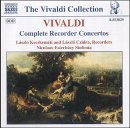
Please Note Not All Our New Items Are Shrink Wrapped.All items shipped within 3 working days of payment.Antonio Vivaldi (1678-1741)Complete Recorder ConcertosAntonio Vivaldi was born in 1678, the son of a barber who later served as a violinist at the great Basilica of San Marco, where the Gabrielis and then Monteverdi had presided. Vivaldi studied for the priesthood and was ordained in 1703. At the same time he won a reputation for himself as a violinist of phenomenal ability and was appointed violin-master at the Ospedale della Pietà. This last was one of four such charitable institutions, established for the education of orphan, indigent or illegitimate girls and boasting a particularly fine musical tradition, which attracted visitors to Venice from other countries. Here the girls were trained in music, some of the more talented continuing to serve there as assistant teachers, earning the dowry necessary for marriage. Vivaldis association with the Pietà continued intermittently throughout his life, interrupted in 1718 when he moved for three years to Mantua as Maestro di Cappella da Camera to Prince Philip of Hesse-Darmstadt, appointed governor of the city by the Emperor in Vienna. In Venice again, in 1723 Vivaldi returned to the Pietà under a freer form of contract that provided at first for the composition of two new concertos every month, some of which he would himself direct. At the same time he enjoyed a connection with the theatre, as the composer of some fifty operas, and possibly many more, and as director and manager. He finally left Venice in 1741, travelling to Vienna, where there seemed some possibility of furthering his career under the imperial patronage of Charles VI, whose relatively sudden death proved as inopportune for Vivaldi as it did for the Habsburg dynasty. Vivaldi died in Vienna in July, a month to the day from his arrival in the city, in relative poverty. At one time he had been worth 50,000 ducats a year, it seemed, but now had little to show for it, as he arranged for the sale of some of the music he had brought with him. In perfecting the newly developing form of the Italian solo concerto Vivaldi played an important part. He left nearly five hundred concertos. Many of these were for his own instrument, the violin, but there were others for a variety of solo instruments or for groups of instruments. He claimed to be able to compose a new work quicker than a copyist could write it out, and he clearly coupled immense facility with a remarkable capacity for variety within the confines of the three-movement form, with its faster outer movements framing a central slow movement.Vivaldi wrote three solo concertos for the flautino, an instrument on the identity of which there has been some speculation. It seems now agreed, however, that the instrument in question is the sopranino recorder, and not the piccolo, an instrument that makes its appearance later in the century, or the flageolet, usually so designated by Vivaldi. He shows no mercy to the little recorder, an instrument pitched an octave above
(Allegro)
Largo
Allegro Molto
Allegro
Larghetto
(Allegro)
Allegro Non Molto
Largo
Allegro Molto
Allegro Ma Non Molto
Largo E Cantabile
Allegro
Allegro Non Molto
Largo
(Allegro)
Allegro
Largo
Allegro
Track Listing
(Allegro)
Largo
Allegro Molto
Allegro
Larghetto
(Allegro)
Allegro Non Molto
Largo
Allegro Molto
Allegro Ma Non Molto
Largo E Cantabile
Allegro
Allegro Non Molto
Largo
(Allegro)
Allegro
Largo
Allegro
Details
- Genre: Classical
- Product Type: AUDIO CD
- Barcode: 730099482929
Delivery and Returns
Dispatch Information: Dispatch times vary by item and items are only dispatched on UK working days – not weekends or UK Bank Holidays. Items marked "Dispatched Same Day" will be dispatched on the day of purchase if bought before 2pm GMT. "Dispatched Same Day" items bought after 2pm GMT or on a non-working day will be dispatched on the next working day. For all other items the dispatch timeframe is clearly labelled on the product page.
Delivery Information: We aim to deliver your order as quickly and efficiently as possible. All UK orders are dispatched using Royal Mail 48 Tracked service and the standard delivery times are 2-3 business days. Please note that delivery times for overseas orders will vary depending on your location and the shipping option you choose during checkout.
Shipping Costs: We offer free delivery on all UK orders and free worldwide delivery on orders over £15.
Tracking Your Order: All UK orders are tracked. Once your order is dispatched, you will receive a tracking number via email. You can use this tracking number to monitor the progress of your delivery on the Royal Mail Track and Trace website.
Returns and Exchanges: We want you to be completely satisfied with your purchase. If for any reason you are not happy with your order, you may return it within 28 days of the item being dispatched for a refund or exchange. Please note the following guidelines:
- Items must be returned in their original condition and packaging – items that have been opened or had shrink wrap removed are not eligible for return or refund.
- Make sure to include your order number in the returned package.
How to Initiate a Return: To initiate a return or exchange, please contact our customer service team. The team is available to assist you with any questions or concerns you may have about the process.
Refund Processing: Refunds will be processed as soon as we receive your item back into our warehouse. Replacements are subject to availability and if a replacement is not available, a refund will be issued.
If you have any further questions or need assistance, please don't hesitate to contact our customer service team or check out our FAQ’s. We're here to help ensure your shopping experience is enjoyable and hassle-free. Thank you for choosing Chalkys!
Delivery Information: We aim to deliver your order as quickly and efficiently as possible. All UK orders are dispatched using Royal Mail 48 Tracked service and the standard delivery times are 2-3 business days. Please note that delivery times for overseas orders will vary depending on your location and the shipping option you choose during checkout.
Shipping Costs: We offer free delivery on all UK orders and free worldwide delivery on orders over £15.
Tracking Your Order: All UK orders are tracked. Once your order is dispatched, you will receive a tracking number via email. You can use this tracking number to monitor the progress of your delivery on the Royal Mail Track and Trace website.
Returns and Exchanges: We want you to be completely satisfied with your purchase. If for any reason you are not happy with your order, you may return it within 28 days of the item being dispatched for a refund or exchange. Please note the following guidelines:
- Items must be returned in their original condition and packaging – items that have been opened or had shrink wrap removed are not eligible for return or refund.
- Make sure to include your order number in the returned package.
How to Initiate a Return: To initiate a return or exchange, please contact our customer service team. The team is available to assist you with any questions or concerns you may have about the process.
Refund Processing: Refunds will be processed as soon as we receive your item back into our warehouse. Replacements are subject to availability and if a replacement is not available, a refund will be issued.
If you have any further questions or need assistance, please don't hesitate to contact our customer service team or check out our FAQ’s. We're here to help ensure your shopping experience is enjoyable and hassle-free. Thank you for choosing Chalkys!