Skip to product information
1 of 1
Regular price £12.48
Regular price Sale price £12.48
Sale Sold out
Brand New From Reputable UK Company With 30 Years Experience In Retail, Please Note Not All Our New Items Are Shrink Wrapped.
All items shipped within 3 working days of payment.
Please note that all our DVDs are Region 2.


Please note that not all audio CDs are shrink-wrapped fom the factory.


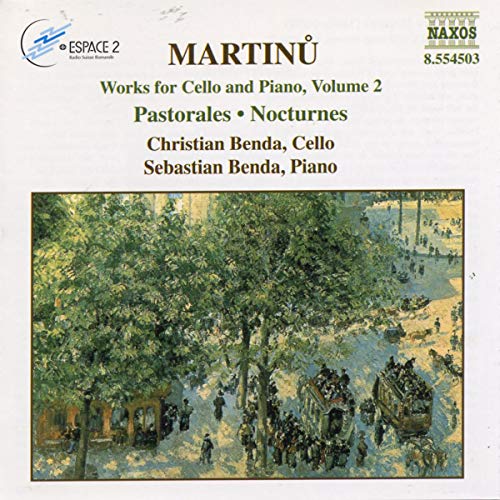
Bohuslav Martinů(1890-1959) Works for Cello andPiano, Volume 2The Czech composer Bohuslav Martinů was born in 1890 atthe country town of Polička in the mountains of Bohemia and Moravia. Hisfather, a shoe-maker by trade, was employed also as town watchman, living inthe bell-tower of the church of St Jakob, the highest vantage-point in thetown, with the task of keeping Polička from any recurrence of the firethat had devastated it earlier in the century. It was here that Martinů was born in 1890. In his childhood he learnedthe violin from a local tailor and made a local reputation for himself, givinghis first public concert in his home?\xa1town in 1905. At the same time he made hisfirst untutored attempts at composition. It was through the generosity of someof the citizens of Polička that in 1906 he was able to enter the PragueConservatory. There, however, he found the routine of the Violin School irksomeand was consequently transferred in 1909 to the Organ School, where he againfailed to distinguish himself. Expelled in 1910, he remained in Prague, nowconcentrating on composition and narrowly qualifying as a teacher.During the war Martinů taught the violin inhis home-town, avoiding military service, for which he was medically unfit, andin 1918 he was able to join the Czech Philharmonic Orchestra, where hebroadened his musical experience while continuing to compose work after work.At the Conservatory he had enjoyed a brief period of instruction from Josef Sukbut in 1923, assisted by a scholarship, he moved to Paris to study with AlbertRoussel.In the following years Martinů's music began to gaina hearing internationally and at home. By 1931, still in Paris, he hadestablished himself well enough to marry a young dressmaker, although he neverearned enough to allow even reasonable comfort. The German invasion of Czechoslovakiaand the annexation of the country in 1939, coupled with the threat of widerconflict, was both horrifying and alarming. Eventually, in June 1940, four daysbefore the German capture of Paris, Martinů and his wife madetheir escape, finding their way with considerable difficulty to Portugal andthence to Bermuda, to reach New York at the end of March 1941. In Americaduring the war there were commissions from various quarters, notably from theKoussevitzky Foundation, for which he wrote his First Symphony.After the war Martinů had hoped to returnto Prague, where he had been offered the position of professor of compositionat the Academy of Music and Dramatic Art. His return to Europe was delayed byillness, after a fall at Tanglewood, where he had been invited to lecture, andany possibility of working again in hi, home-country was obviated by theaccession to power of the Communists in 1948. For some five years he remainedin the United States as professor of composition at Princeton, returning toEurope in 1953. Until 1955 he lived in Nice, then moving to Philadelphia toteach at the Curtis Instit

Variations on a theme by Rossini

Variations on a Slovakian theme

Pastorales

Nocturnes. Quatre etudes pour violoncelle

Suite Miniature

Vars On A Theme Of Rossini: Theme: Vivo Moderato Maestoso

Vars On A Slovakian Theme: Theme: Poco Andante, Rubato

Vars On A Slovakian Theme: Var I: Moderato

Vars On A Slovakian Theme: Var II: Poco Allegro

Vars On A Slovakian Theme: Var III: Moderato

Vars On A Slovakian Theme: Var IV: Scherzo, Allegretto

Vars On A Slovakian Theme: Variation V: Allegro

Pastorales: Six Pieces: I. Andante

Pastorales: Six Pieces: II. Allegretto Moderato

Pastorales: Six Pieces: III. Adagio

Pastorales: Six Pieces: IV. Moderato

Pastorales: Six Pieces: V. Largo

Pastorales: Six Pieces: VI. Allegretto

Nocturnes: Four Studies: I. Andantino Moderato

Nocturnes: Four Studies: II. Lento

Nocturnes: Four Studies: III. Moderato

Nocturnes: Four Studies: IV. Allegretto Moderato

Ste Miniature: Seven Easy Pieces: I. Moderato

Ste Miniature: Seven Easy Pieces: II. Poco Andante

Ste Miniature: Seven Easy Pieces: III. Poco Moderato

Ste Miniature: Seven Easy Pieces: IV. Andante

Ste Miniature: Seven Easy Pieces: V. Poco Allegro

Ste Miniature: Seven Easy Pieces: VI. Allegretto

Ste Miniature: Seven Easy Pieces: VII. Moderato

View full details
Description
Please Note Not All Our New Items Are Shrink Wrapped.All items shipped within 3 working days of payment.Bohuslav Martinů(1890-1959) Works for Cello andPiano, Volume 2The Czech composer Bohuslav Martinů was born in 1890 atthe country town of Polička in the mountains of Bohemia and Moravia. Hisfather, a shoe-maker by trade, was employed also as town watchman, living inthe bell-tower of the church of St Jakob, the highest vantage-point in thetown, with the task of keeping Polička from any recurrence of the firethat had devastated it earlier in the century. It was here that Martinů was born in 1890. In his childhood he learnedthe violin from a local tailor and made a local reputation for himself, givinghis first public concert in his home?xa1town in 1905. At the same time he made hisfirst untutored attempts at composition. It was through the generosity of someof the citizens of Polička that in 1906 he was able to enter the PragueConservatory. There, however, he found the routine of the Violin School irksomeand was consequently transferred in 1909 to the Organ School, where he againfailed to distinguish himself. Expelled in 1910, he remained in Prague, nowconcentrating on composition and narrowly qualifying as a teacher.During the war Martinů taught the violin inhis home-town, avoiding military service, for which he was medically unfit, andin 1918 he was able to join the Czech Philharmonic Orchestra, where hebroadened his musical experience while continuing to compose work after work.At the Conservatory he had enjoyed a brief period of instruction from Josef Sukbut in 1923, assisted by a scholarship, he moved to Paris to study with AlbertRoussel.In the following years Martinů's music began to gaina hearing internationally and at home. By 1931, still in Paris, he hadestablished himself well enough to marry a young dressmaker, although he neverearned enough to allow even reasonable comfort. The German invasion of Czechoslovakiaand the annexation of the country in 1939, coupled with the threat of widerconflict, was both horrifying and alarming. Eventually, in June 1940, four daysbefore the German capture of Paris, Martinů and his wife madetheir escape, finding their way with considerable difficulty to Portugal andthence to Bermuda, to reach New York at the end of March 1941. In Americaduring the war there were commissions from various quarters, notably from theKoussevitzky Foundation, for which he wrote his First Symphony.After the war Martinů had hoped to returnto Prague, where he had been offered the position of professor of compositionat the Academy of Music and Dramatic Art. His return to Europe was delayed byillness, after a fall at Tanglewood, where he had been invited to lecture, andany possibility of working again in hi, home-country was obviated by theaccession to power of the Communists in 1948. For some five years he remainedin the United States as professor of composition at Princeton, returning toEurope in 1953. Until 1955 he lived in Nice, then moving to Philadelphia toteach at the Curtis Instit

Variations on a theme by Rossini

Variations on a Slovakian theme

Pastorales

Nocturnes. Quatre etudes pour violoncelle

Suite Miniature

Vars On A Theme Of Rossini: Theme: Vivo Moderato Maestoso

Vars On A Slovakian Theme: Theme: Poco Andante, Rubato

Vars On A Slovakian Theme: Var I: Moderato

Vars On A Slovakian Theme: Var II: Poco Allegro

Vars On A Slovakian Theme: Var III: Moderato

Vars On A Slovakian Theme: Var IV: Scherzo, Allegretto

Vars On A Slovakian Theme: Variation V: Allegro

Pastorales: Six Pieces: I. Andante

Pastorales: Six Pieces: II. Allegretto Moderato

Pastorales: Six Pieces: III. Adagio

Pastorales: Six Pieces: IV. Moderato

Pastorales: Six Pieces: V. Largo

Pastorales: Six Pieces: VI. Allegretto

Nocturnes: Four Studies: I. Andantino Moderato

Nocturnes: Four Studies: II. Lento

Nocturnes: Four Studies: III. Moderato

Nocturnes: Four Studies: IV. Allegretto Moderato

Ste Miniature: Seven Easy Pieces: I. Moderato

Ste Miniature: Seven Easy Pieces: II. Poco Andante

Ste Miniature: Seven Easy Pieces: III. Poco Moderato

Ste Miniature: Seven Easy Pieces: IV. Andante

Ste Miniature: Seven Easy Pieces: V. Poco Allegro

Ste Miniature: Seven Easy Pieces: VI. Allegretto

Ste Miniature: Seven Easy Pieces: VII. Moderato

Details
  • Genre: Classical
  • Product Type: AUDIO CD
  • Barcode: 636943450321
Delivery and Returns
Dispatch Information: Dispatch times vary by item and items are only dispatched on UK working days – not weekends or UK Bank Holidays. Items marked "Dispatched Same Day" will be dispatched on the day of purchase if bought before 2pm GMT. "Dispatched Same Day" items bought after 2pm GMT or on a non-working day will be dispatched on the next working day. We aim to dispatch all other items within 3-5 working days.

Delivery Information: We aim to deliver your order as quickly and efficiently as possible. All UK orders are dispatched using Royal Mail 48 Tracked service and the standard delivery times are 2-3 business days. Please note that delivery times for overseas orders will vary depending on your location and the shipping option you choose during checkout.

Shipping Costs: We offer free delivery on all UK orders and free worldwide delivery on orders over £15.

Tracking Your Order: All UK orders are tracked. Once your order is dispatched, you will receive a tracking number via email. You can use this tracking number to monitor the progress of your delivery on the Royal Mail Track and Trace website.

Returns and Exchanges: We want you to be completely satisfied with your purchase. If for any reason you are not happy with your order, you may return it within 28 days of the item being dispatched for a refund or exchange. Please note the following guidelines:
- Items must be returned in their original condition and packaging – items that have been opened or had shrink wrap removed are not eligible for return or refund.
- Make sure to include your order number in the returned package.

How to Initiate a Return: To initiate a return or exchange, please contact our customer service team. The team is available to assist you with any questions or concerns you may have about the process.

Refund Processing: Refunds will be processed as soon as we receive your item back into our warehouse. Replacements are subject to availability and if a replacement is not available, a refund will be issued.

If you have any further questions or need assistance, please don't hesitate to contact our customer service team or check out our FAQ’s. We're here to help ensure your shopping experience is enjoyable and hassle-free. Thank you for choosing Chalkys!