

Description
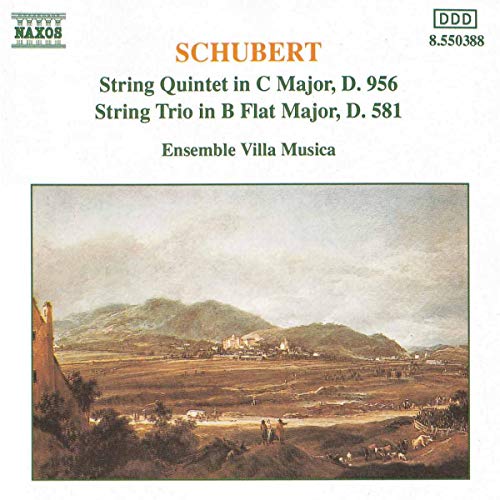
Please Note Not All Our New Items Are Shrink Wrapped.All items shipped within 3 working days of payment.Franz Schubert (1797 - 1828)String Quintet in C Major, D. 956String Trio in B Flat Major, D. 581Vienna has always claimed Franz Schubert as peculiarly its own. Others, such as Mozart, Haydn and Beethoven, had made their home there, but Schubert was a native of the city. Nevertheless his parents had moved to the capital from other parts of the Empire, his father from Moravia and his mother from Silesia. Schubert's father was a schoolmaster, a profession that it seemed likely his son might in the end follow. As a boy, the fourth of fourteen children of whom only five survived, he was trained as a choir boy of the Imperial Chapel, under Antonio Salieri, and, in consequence, as a pupil of the Staatskonvikt, where he took a leading part in orchestral activities, as he had in family chamber music. His first surviving compositions date from 1810, his second year of study.When his voice broke, at the age of fifteen, Schubert was offered a scholarship for further academic study, but rejected this in the hope of being able to devote his time more fully to music. In 1817 he took the customary short course to qualify him as a primary schoolteacher and the following year joined his father as an assistant in a profession for which he never showed the least aptitude. Already he had proved prolific as a composer, with a particular facility in setting words to music and a gift for apt melody. In the course of his short life, however, he was never to gain full recognition with any official employment. Much of his music was performed at private gatherings, to the delight of his friends, in whose company he took the greatest pleasure, intermittently deserting the classroom for the freedom of lodgings shared with his friend Schober and later with Mayrhofer.Schubert's final years were darkened by illness and the probability of an early death, as a then incurable venereal infection took its toll. In 1828 there was the first public concert devoted to his music, some of which had already been published, while other publishers had begun to show some interest, particularly in more readily marketable products for the gifted amateur. On his doctors' advice he moved to the Vienna suburb of Wieden to stay with his brother Ferdinand, but in spite of intermittent bouts of energy, he became increasingly debilitated and died on the afternoon of 19th November.The B Flat String Trio, D. 581, was written in September, 1817, a year after Schubert's first surviving attempt at the form, an incomplete B flat Trio started in 1816. The form itself, with violin, viola and cello, presents its own particular challenge. Haydn made significant use of it, and Mozart contributed a work in concertante style. Beethoven wrote string trios in both a four-movement form, the structural counterpart of the string quartet and in the six-movement divertimento style, with alternating dance-movements. Schubert takes the first as a model, with an opening movement of transparent texture that fol
Str Qnt in C, D.956, Op.163: Allegro ma non troppo
Str Qnt in C, D.956, Op.163: Adagio
Str Qnt in C, D.956, Op.163: Scherzo: Presto
Str Qnt in C, D.956, Op.163: Allegretto
Str Trio in B Flat, D.581: Allegro moderato
Str Trio in B Flat, D.581: Andante
Str Trio in B Flat, D.581: Menuetto: Allegretto
Str Trio in B Flat, D.581: Rondo: Allegretto
Details
- Genre: Classical
- Product Type: AUDIO CD
- Barcode: 4891030503885
Delivery and Returns
Dispatch Information: Dispatch times vary by item and items are only dispatched on UK working days – not weekends or UK Bank Holidays. Items marked "Dispatched Same Day" will be dispatched on the day of purchase if bought before 2pm GMT. "Dispatched Same Day" items bought after 2pm GMT or on a non-working day will be dispatched on the next working day. For all other items the dispatch timeframe is clearly labelled on the product page.
Delivery Information: We aim to deliver your order as quickly and efficiently as possible. All UK orders are dispatched using Royal Mail 48 Tracked service and the standard delivery times are 2-3 business days. Please note that delivery times for overseas orders will vary depending on your location and the shipping option you choose during checkout.
Shipping Costs: We offer free delivery on all UK orders and free worldwide delivery on orders over £15.
Tracking Your Order: All UK orders are tracked. Once your order is dispatched, you will receive a tracking number via email. You can use this tracking number to monitor the progress of your delivery on the Royal Mail Track and Trace website.
Returns and Exchanges: We want you to be completely satisfied with your purchase. If for any reason you are not happy with your order, you may return it within 28 days of the item being dispatched for a refund or exchange. Please note the following guidelines:
- Items must be returned in their original condition and packaging – items that have been opened or had shrink wrap removed are not eligible for return or refund.
- Make sure to include your order number in the returned package.
How to Initiate a Return: To initiate a return or exchange, please contact our customer service team. The team is available to assist you with any questions or concerns you may have about the process.
Refund Processing: Refunds will be processed as soon as we receive your item back into our warehouse. Replacements are subject to availability and if a replacement is not available, a refund will be issued.
If you have any further questions or need assistance, please don't hesitate to contact our customer service team or check out our FAQ’s. We're here to help ensure your shopping experience is enjoyable and hassle-free. Thank you for choosing Chalkys!
Delivery Information: We aim to deliver your order as quickly and efficiently as possible. All UK orders are dispatched using Royal Mail 48 Tracked service and the standard delivery times are 2-3 business days. Please note that delivery times for overseas orders will vary depending on your location and the shipping option you choose during checkout.
Shipping Costs: We offer free delivery on all UK orders and free worldwide delivery on orders over £15.
Tracking Your Order: All UK orders are tracked. Once your order is dispatched, you will receive a tracking number via email. You can use this tracking number to monitor the progress of your delivery on the Royal Mail Track and Trace website.
Returns and Exchanges: We want you to be completely satisfied with your purchase. If for any reason you are not happy with your order, you may return it within 28 days of the item being dispatched for a refund or exchange. Please note the following guidelines:
- Items must be returned in their original condition and packaging – items that have been opened or had shrink wrap removed are not eligible for return or refund.
- Make sure to include your order number in the returned package.
How to Initiate a Return: To initiate a return or exchange, please contact our customer service team. The team is available to assist you with any questions or concerns you may have about the process.
Refund Processing: Refunds will be processed as soon as we receive your item back into our warehouse. Replacements are subject to availability and if a replacement is not available, a refund will be issued.
If you have any further questions or need assistance, please don't hesitate to contact our customer service team or check out our FAQ’s. We're here to help ensure your shopping experience is enjoyable and hassle-free. Thank you for choosing Chalkys!