

Description
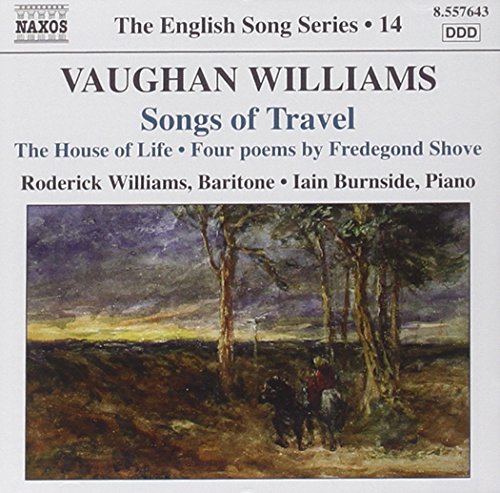
Please Note Not All Our New Items Are Shrink Wrapped.All items shipped within 3 working days of payment.Ralph Vaughan Williams (1872-1958)Songs of Travel The House of Life Four Poems by Fredegond ShoveRalph Vaughan Williams was born in theGloucestershire village of Down Ampney in 1872, theson of a clergyman. His ancestry on both his father's andmother's side was of some intellectual distinction. Hisfather was descended from a family eminent in the law,while his maternal grandfather was a Wedgwood and hisgrandmother a Darwin. On the death of his father in1875 the family moved to live with his mother's fatherat Leith Hill Place in Surrey. As a child VaughanWilliams learned the piano and the violin and received aconventional upper middle class education atCharterhouse, after which he delayed entry toCambridge, preferring instead to study at the RoyalCollege of Music, where his teachers included HubertParry and Walter Parratt, later Master of the Queen'sMusick, both soon to be knighted. In 1892 he took up hisplace at Trinity College, Cambridge, where he readHistory, but took composition lessons from CharlesWood. After graduation in both History and Music, hereturned to the Royal College, where he studiedcomposition with Stanford, and, perhaps moresignificantly, became a friend of a fellow-student,Gustav Holst. The friendship with Holst was to prove ofgreat importance in frank exchanges of views on oneanother's compositions in the years that followed.In 1897 Vaughan Williams married and took theopportunity to visit Berlin, where he had lessons fromMax Bruch and widened his musical experience. InEngland he turned his attention to the collection of folkmusicin various regions of the country, an interest thatmaterially influenced the shape of his musical language.In 1908 he went to Paris to take lessons, particularly inorchestration, from Ravel. By now he had begun tomake a reputation for himself as a composer, not leastwith the first performance in 1910 of A Sea Symphony,setting words by Walt Whitman, and his Fantasia on aTheme of Thomas Tallis in the same year. At theoutbreak of war in 1914 he enlisted at once in the RoyalArmy Medical Corps as a private. This was also the yearof the London Symphony and of his rhapsodic work forviolin and orchestra, The Lark Ascending. Three yearslater, after service in Salonica that seemed to himineffective, he took a commission in the Royal GarrisonArtillery and was posted to France. There he was alsoable to make some use of his abilities as a musician.After the war Vaughan Williams returned to theRoyal College of Music, now as a professor ofcomposition, a position he retained until 1938. In theseyears he came to occupy a commanding place in themusical life of the country, with a series of compositionsthat seemed essentially English, the apparent successorof Elgar, although his musical language was markedlydifferent. The war of 1939 brought the challenge ofcomposition for the cinema, with notable scores for The49th Parallel in 1940 and a number of other films,culminating in 1949 in his music for the film Scott of theA
The Vagabond
Let Beauty Awake
The Roadside Fire
Youth And Love
In Dreams
I Infinite Shining Heavens
Whither Must I Wander?
Bright Is The Ring Of Words
I Have Trod The Upward And The Downward Slope
Love-Sight
Silent Noon
Love's Minstrels
Heart's Haven
Death In Love
Love's Last Gift
Linden Lea
Motion And Stillness
Four Nights
The New Ghost
The Water Mill
Details
- Genre: Classical
- Product Type: AUDIO CD
- Barcode: 747313264322
Delivery and Returns
Dispatch Information: Dispatch times vary by item and items are only dispatched on UK working days – not weekends or UK Bank Holidays. Items marked "Dispatched Same Day" will be dispatched on the day of purchase if bought before 2pm GMT. "Dispatched Same Day" items bought after 2pm GMT or on a non-working day will be dispatched on the next working day. For all other items the dispatch timeframe is clearly labelled on the product page.
Delivery Information: We aim to deliver your order as quickly and efficiently as possible. All UK orders are dispatched using Royal Mail 48 Tracked service and the standard delivery times are 2-3 business days. Please note that delivery times for overseas orders will vary depending on your location and the shipping option you choose during checkout.
Shipping Costs: We offer free delivery on all UK orders and free worldwide delivery on orders over £15.
Tracking Your Order: All UK orders are tracked. Once your order is dispatched, you will receive a tracking number via email. You can use this tracking number to monitor the progress of your delivery on the Royal Mail Track and Trace website.
Returns and Exchanges: We want you to be completely satisfied with your purchase. If for any reason you are not happy with your order, you may return it within 28 days of the item being dispatched for a refund or exchange. Please note the following guidelines:
- Items must be returned in their original condition and packaging – items that have been opened or had shrink wrap removed are not eligible for return or refund.
- Make sure to include your order number in the returned package.
How to Initiate a Return: To initiate a return or exchange, please contact our customer service team. The team is available to assist you with any questions or concerns you may have about the process.
Refund Processing: Refunds will be processed as soon as we receive your item back into our warehouse. Replacements are subject to availability and if a replacement is not available, a refund will be issued.
If you have any further questions or need assistance, please don't hesitate to contact our customer service team or check out our FAQ’s. We're here to help ensure your shopping experience is enjoyable and hassle-free. Thank you for choosing Chalkys!
Delivery Information: We aim to deliver your order as quickly and efficiently as possible. All UK orders are dispatched using Royal Mail 48 Tracked service and the standard delivery times are 2-3 business days. Please note that delivery times for overseas orders will vary depending on your location and the shipping option you choose during checkout.
Shipping Costs: We offer free delivery on all UK orders and free worldwide delivery on orders over £15.
Tracking Your Order: All UK orders are tracked. Once your order is dispatched, you will receive a tracking number via email. You can use this tracking number to monitor the progress of your delivery on the Royal Mail Track and Trace website.
Returns and Exchanges: We want you to be completely satisfied with your purchase. If for any reason you are not happy with your order, you may return it within 28 days of the item being dispatched for a refund or exchange. Please note the following guidelines:
- Items must be returned in their original condition and packaging – items that have been opened or had shrink wrap removed are not eligible for return or refund.
- Make sure to include your order number in the returned package.
How to Initiate a Return: To initiate a return or exchange, please contact our customer service team. The team is available to assist you with any questions or concerns you may have about the process.
Refund Processing: Refunds will be processed as soon as we receive your item back into our warehouse. Replacements are subject to availability and if a replacement is not available, a refund will be issued.
If you have any further questions or need assistance, please don't hesitate to contact our customer service team or check out our FAQ’s. We're here to help ensure your shopping experience is enjoyable and hassle-free. Thank you for choosing Chalkys!