

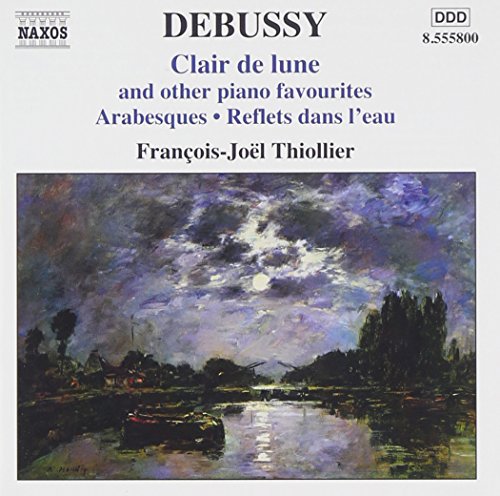
Description
Please Note Not All Our New Items Are Shrink Wrapped.All items shipped within 3 working days of payment.Claude Debussy (1862-1918)Clair de lune and other favourite piano worksDebussy was born in 1862 in St Germain-en-Laye, the son of ashop-keeper who was later to turn his hand to other activities, with varyingsuccess. He started piano lessons at the age of seven and continued two yearslater, improbably enough, with Verlaine's mother-in-law, allegedly a pupil ofChopin. In 1872 he entered the Paris Conservatoire, where he abandoned the planof becoming a virtuoso pianist, turning his principal attention to composition.In 1880, at the age of eighteen, he was employed by Tchaikovsky's patronessNadezhda von Meck as tutor to her children and house-musician. On his return tothe Conservatoire he entered the class of Bizet's friend Ernest Guiraud and in1883 won the second Prix de Rome. In 1884 he won the first prize, the followingyear reluctantly taking up obligatory residence, according to the terms of theaward, at the Villa Medici in Rome, where he met Liszt. By 1887 he was back inParis, winning his first significant success in 1900 with Nocturnes and goingon, two years later, to a succ?xbfs de scandale with his opera Pelleas etMelisande, based on the play by Maurice Maeterlinck, a work that establishedhis position as a composer of importance.Debussy's personal life brought some unhappiness in hisfirst marriage in 1899 to a mannequin, Lily Texier, after a liaison of someseven years with Gabrielle Dupont and a brief engagement in 1894 to the singerTher?xbfse Roger. His association from 1903 with Emma Bardac, the wife of a bankerand a singer of some ability, led eventually to their marriage in 1908, afterthe birth of their daughter three years earlier. In 1904 he had abandoned hiswife, moving into an apartment with Emma Bardac, and the subsequent attempt atsuicide by the former, who had shared with him many of the difficulties of hisearly career, alienated a number of his friends. His final years were darkenedby the war and by cancer, the cause of his death in March 1918, when he leftunfinished a planned series of chamber music works, only three of which hadbeen completed.As a composer Debussy must be regarded as one of the mostimportant and influential figures of the earlier twentieth century. His musicallanguage suggested new paths to be further explored, while his poetic andsensitive use of the orchestra and of keyboard textures opened still morepossibilities. His opera Pelleas et Melisande and his songs demonstrated a deepunderstanding of poetic language, revealed by his music, expressed in termsthat never overstated or exaggerated.It is difficult to hear [1] Clair de lune (Moonlight) withnew ears, so familiar did it become, even in Debussy's lifetime. Poetic andevocative, it suggests the nostalgic world conjured up by Verlaine in his F?xactesgalantes and formed part of Debussy's Suite bergamasque written between 1890and 1905.[2] La plus que lente, a waltz that is slower than a slowwaltz, dates from 1910 and has the direction Molto rubato con morbidezza, ahint
Clair De Lune
La Plus Que Lente
Arabesque No.1
Le Petit Negre
The Snow Is Dancing
The Little Shepherd
Golliwog's Cakewalk
La Soiree Dans Grenade
Jardins Sous La Pluie
Arabesque No.2
Valse Romantique
Danse (Tarantelle Styrienne)
Toccata
Reflets Dans L'eau
Poissons D'or
Mazurka
Reverie
La Fille Aux Cheveux De Lin
Minstrels
La Cathedrale Engloutie
Details
- Genre: Classical
- Product Type: AUDIO CD
- Barcode: 747313580026
Delivery and Returns
Dispatch Information: Dispatch times vary by item and items are only dispatched on UK working days – not weekends or UK Bank Holidays. Items marked "Dispatched Same Day" will be dispatched on the day of purchase if bought before 2pm GMT. "Dispatched Same Day" items bought after 2pm GMT or on a non-working day will be dispatched on the next working day. For all other items the dispatch timeframe is clearly labelled on the product page.
Delivery Information: We aim to deliver your order as quickly and efficiently as possible. All UK orders are dispatched using Royal Mail 48 Tracked service and the standard delivery times are 2-3 business days. Please note that delivery times for overseas orders will vary depending on your location and the shipping option you choose during checkout.
Shipping Costs: We offer free delivery on all UK orders and free worldwide delivery on orders over £15.
Tracking Your Order: All UK orders are tracked. Once your order is dispatched, you will receive a tracking number via email. You can use this tracking number to monitor the progress of your delivery on the Royal Mail Track and Trace website.
Returns and Exchanges: We want you to be completely satisfied with your purchase. If for any reason you are not happy with your order, you may return it within 28 days of the item being dispatched for a refund or exchange. Please note the following guidelines:
- Items must be returned in their original condition and packaging – items that have been opened or had shrink wrap removed are not eligible for return or refund.
- Make sure to include your order number in the returned package.
How to Initiate a Return: To initiate a return or exchange, please contact our customer service team. The team is available to assist you with any questions or concerns you may have about the process.
Refund Processing: Refunds will be processed as soon as we receive your item back into our warehouse. Replacements are subject to availability and if a replacement is not available, a refund will be issued.
If you have any further questions or need assistance, please don't hesitate to contact our customer service team or check out our FAQ’s. We're here to help ensure your shopping experience is enjoyable and hassle-free. Thank you for choosing Chalkys!
Delivery Information: We aim to deliver your order as quickly and efficiently as possible. All UK orders are dispatched using Royal Mail 48 Tracked service and the standard delivery times are 2-3 business days. Please note that delivery times for overseas orders will vary depending on your location and the shipping option you choose during checkout.
Shipping Costs: We offer free delivery on all UK orders and free worldwide delivery on orders over £15.
Tracking Your Order: All UK orders are tracked. Once your order is dispatched, you will receive a tracking number via email. You can use this tracking number to monitor the progress of your delivery on the Royal Mail Track and Trace website.
Returns and Exchanges: We want you to be completely satisfied with your purchase. If for any reason you are not happy with your order, you may return it within 28 days of the item being dispatched for a refund or exchange. Please note the following guidelines:
- Items must be returned in their original condition and packaging – items that have been opened or had shrink wrap removed are not eligible for return or refund.
- Make sure to include your order number in the returned package.
How to Initiate a Return: To initiate a return or exchange, please contact our customer service team. The team is available to assist you with any questions or concerns you may have about the process.
Refund Processing: Refunds will be processed as soon as we receive your item back into our warehouse. Replacements are subject to availability and if a replacement is not available, a refund will be issued.
If you have any further questions or need assistance, please don't hesitate to contact our customer service team or check out our FAQ’s. We're here to help ensure your shopping experience is enjoyable and hassle-free. Thank you for choosing Chalkys!