

Description
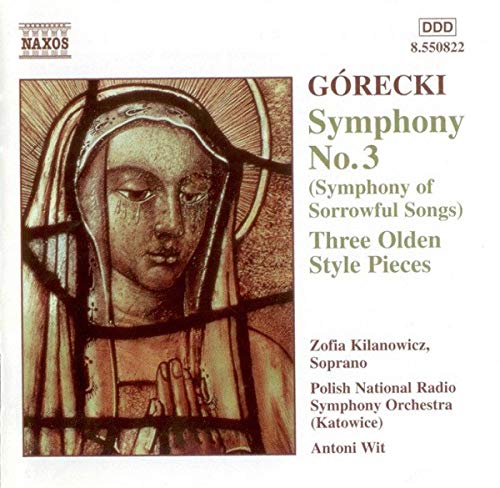
Please Note Not All Our New Items Are Shrink Wrapped.All items shipped within 3 working days of payment.Henryk Górecki (b. 1933) Symphony No.3, Op. 36 (Symphony of Sorrowful Songs) Three Pieces in Olden Style The Polish composer Henryk Górecki was born in Silesia in 1933 and studied at the Katowice Conservatory and in Paris with Olivier Messiaen. He has made his subsequent career largely in Katowice, where he was appointed as a member of the Conservatory teaching staff. He has won a number of important awards for composition both at home and abroad, but earlier successes have been eclipsed by the phenomenal popularity of his Third Symphony, which has had a much wider appeal than could have been forecast, in part because of the relatively approachable musical language in which it is couched and in part because of its peculiar relevance to the mood of today, its anxieties, sorrows and hopes. Górecki's musical idiom has developed gradually into a language of great originality. In earlier years influenced by serialism, in common with many other composers, he later shows the more overt influence of Messiaen and above all a preoccupation with instrumental sonorities. His interest in earlier music, in devotional texts and music often of Medieval origin, coupled with a fascination with the resources of the modern orchestra is often evident. The Third Symphony was written in Katowice between October and December 1976 and dedicated to Górecki's wife. It was first performed at the avant-garde Festival of Royan the following year. The first movement opens with a canon for strings, building gradually through the possible orchestral register, starting with the double basses and mounting in pitch and intensity, as each part enters in imitation. At the heart of the movement is the 15th century Polish Lamentation of the Holy Cross Monastery, in which the Mother of Christ begs her dying Son to speak to her. After this the canon resumes, descending, as before it had risen, in both pitch and intensity, slowly unwinding to end with the single melodic line, the cantus firmus with which the movement had begun. The second and third movements of the symphony together are as long as the first movement. All three are marked Lento, but this direction conceals many nuances of tempo, delicate and subtle changes of pace. The second movement offers an immediate contrast to the sombre elegiac tone of the first. The words of the song are none the less tragic, a prayer scratched on the wall of a Gestapo cell by an eighteen-year-old Polish girl seeking the protection of the Queen of Heaven. The melodic line, with its accompaniment of clustered sonorities, is sad but lyrical in its gentle beauty, touching the heart of the listener in part because of its textual and historical source, to which the music adds even greater poignancy. A repeated motif introduces the third movement, with its folk-song in which a mother laments the loss of her son, whose body she now seeks, the insistent ostinato of the orchestra pointing a melodic line of the greatest simplicity
Sym No.3, Op.36 (Sym of Sorrowful Songs): Lento-Sostenuto tranquillo ma cantabile
Sym No.3, Op.36 (Sym of Sorrowful Songs): Lento-e largo-Tranquillisimo
Sym No.3, Op.36 (Sym of Sorrowful Songs): Lento-Cantabile semplice
3 Olden Style Pieces: I
3 Olden Style Pieces: II
3 Olden Style Pieces: III
Details
- Genre: Classical
- Product Type: AUDIO CD
- Barcode: 4891030508224
Delivery and Returns
Dispatch Information: Dispatch times vary by item and items are only dispatched on UK working days – not weekends or UK Bank Holidays. Items marked "Dispatched Same Day" will be dispatched on the day of purchase if bought before 2pm GMT. "Dispatched Same Day" items bought after 2pm GMT or on a non-working day will be dispatched on the next working day. For all other items the dispatch timeframe is clearly labelled on the product page.
Delivery Information: We aim to deliver your order as quickly and efficiently as possible. All UK orders are dispatched using Royal Mail 48 Tracked service and the standard delivery times are 2-3 business days. Please note that delivery times for overseas orders will vary depending on your location and the shipping option you choose during checkout.
Shipping Costs: We offer free delivery on all UK orders and free worldwide delivery on orders over £15.
Tracking Your Order: All UK orders are tracked. Once your order is dispatched, you will receive a tracking number via email. You can use this tracking number to monitor the progress of your delivery on the Royal Mail Track and Trace website.
Returns and Exchanges: We want you to be completely satisfied with your purchase. If for any reason you are not happy with your order, you may return it within 28 days of the item being dispatched for a refund or exchange. Please note the following guidelines:
- Items must be returned in their original condition and packaging – items that have been opened or had shrink wrap removed are not eligible for return or refund.
- Make sure to include your order number in the returned package.
How to Initiate a Return: To initiate a return or exchange, please contact our customer service team. The team is available to assist you with any questions or concerns you may have about the process.
Refund Processing: Refunds will be processed as soon as we receive your item back into our warehouse. Replacements are subject to availability and if a replacement is not available, a refund will be issued.
If you have any further questions or need assistance, please don't hesitate to contact our customer service team or check out our FAQ’s. We're here to help ensure your shopping experience is enjoyable and hassle-free. Thank you for choosing Chalkys!
Delivery Information: We aim to deliver your order as quickly and efficiently as possible. All UK orders are dispatched using Royal Mail 48 Tracked service and the standard delivery times are 2-3 business days. Please note that delivery times for overseas orders will vary depending on your location and the shipping option you choose during checkout.
Shipping Costs: We offer free delivery on all UK orders and free worldwide delivery on orders over £15.
Tracking Your Order: All UK orders are tracked. Once your order is dispatched, you will receive a tracking number via email. You can use this tracking number to monitor the progress of your delivery on the Royal Mail Track and Trace website.
Returns and Exchanges: We want you to be completely satisfied with your purchase. If for any reason you are not happy with your order, you may return it within 28 days of the item being dispatched for a refund or exchange. Please note the following guidelines:
- Items must be returned in their original condition and packaging – items that have been opened or had shrink wrap removed are not eligible for return or refund.
- Make sure to include your order number in the returned package.
How to Initiate a Return: To initiate a return or exchange, please contact our customer service team. The team is available to assist you with any questions or concerns you may have about the process.
Refund Processing: Refunds will be processed as soon as we receive your item back into our warehouse. Replacements are subject to availability and if a replacement is not available, a refund will be issued.
If you have any further questions or need assistance, please don't hesitate to contact our customer service team or check out our FAQ’s. We're here to help ensure your shopping experience is enjoyable and hassle-free. Thank you for choosing Chalkys!