

Description
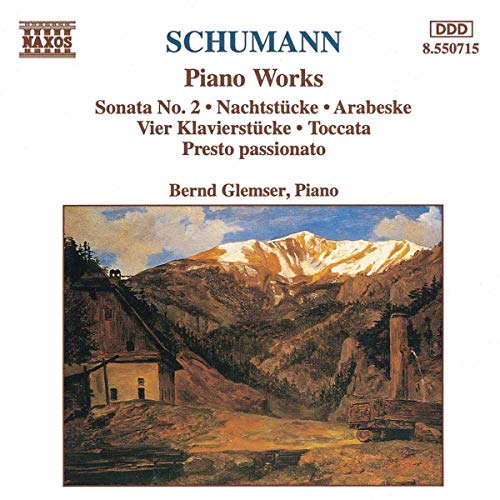
Please Note Not All Our New Items Are Shrink Wrapped.All items shipped within 3 working days of payment.Robert Schumann(1810 - 1856)Sonata No.2 in G Minor, Op. 22Nachtst??cke, Op. 23Arabeske, Op. 18 >Four Piano Pieces / VierKlavierst??cke, Op. 32Toccata in C Major, Op. 7Original Finale / Urspr??nglichesFinale: Presto passionato Robert Schumann must seem in many ways typical of the age inwhich he lived, combining a number of the principal characteristics of Romanticism in hismusic and in his life. Born in Zwickau in 1810, the son of a bookseller, publisher andwriter, he showed an early interest in literature, and was to make a name for himself inlater years as a writer and editor of the Neue Zeitschrift f??r Musik, a journal launchedin 1834.After a period at university, to satisfy the ambitions of hisnow widowed mother, while still showing the wide interests of a dilettante, Schumannturned more fully to music under the tuition of Friedrich Wieck, a famous teacher whoseenergies had been largely directed towards the training of his daughter Clara, a pianistof prodigious early talent. The romance that led in 1840 to, their marriage, in spite of the bitteropposition of Wieck, was followed by a period in which Clara's career as a pianist had, insome way, to be reconciled with her husband's ambitions and the demands of a growingfamily. A weakness in the fingers had caused Schumann to give up the idea of becoming avirtuoso pianist, but he drew attention as a writer on musical matters and, increasingly,as a composer. His final position in D??sseldorf as director of music was not successful,however, and culminated in an attempt at suicide, insanity and death in 1856. Much of Schumann's piano music was written in the 1830s. Theyear of his marriage was a year of song, followed by attempts at works on a much largerscale, with the encouragement of his wife. Early attempts at writing piano sonatas werelargely unfinished, until the Sonata in F sharp minor, published in 1836 with a dedicationto Clara Wieck. In the same year Schumann published a Concertsans orchestre in F minor, re-issued with an additional movement in 1853 as histhird piano sonata. The Sonata No.2 in G minor, Opus 22,was apparently written over a number of years. The second movement Andantino was composedin June 1830, the first and third movements in June 1833 and the original demanding Finalein October 1835. The alternative Finale, written after the objections of Clara Wieck thatthe original Presto passionato was far too difficult, was composed in Vienna in December1838. The sonata was published the following year. The first movement, So rasch wie moglich, as fast as possible, has afirst subject melody based on the descending scale, with a broken chord left-handaccompaniment. The movement is in the established tripartite sonata-allegro form, with acentral development and final recapitulation, ending in a rapid coda. The gentle Andantinooffers a lyrical melody over a repeated chordal accompaniment. The Scherzo has all theenergy of Florestan, the pseudonym used by Schumann to indicate the passionate
So Rasch Wie Moglich
Andantino (getragen)
Scherzo: Sehr rasch und markiert
Rondo: Presto
Mehr langsam oft zuruckhaltend (Trauerzug)
Markiert und lebhaft (Kuriose Gesellschaft)
Mit grosser Lebhaftigkeit (Nachtliches Gelage)
Ad libitum - Einfach (Rundgesang mit Solostimmen)
Arabeske in C Major
Scherzo: Sehr markiert
Gigue: Seht schnell
Romanze: Sehr rasch und mit Bravour
Fughette: Leise
Toccata in C Major
Original Finale of Sonata No. 2
Details
- Genre: Classical
- Product Type: AUDIO CD
- Barcode: 4891030507159
Delivery and Returns
Dispatch Information: Dispatch times vary by item and items are only dispatched on UK working days – not weekends or UK Bank Holidays. Items marked "Dispatched Same Day" will be dispatched on the day of purchase if bought before 2pm GMT. "Dispatched Same Day" items bought after 2pm GMT or on a non-working day will be dispatched on the next working day. For all other items the dispatch timeframe is clearly labelled on the product page.
Delivery Information: We aim to deliver your order as quickly and efficiently as possible. All UK orders are dispatched using Royal Mail 48 Tracked service and the standard delivery times are 2-3 business days. Please note that delivery times for overseas orders will vary depending on your location and the shipping option you choose during checkout.
Shipping Costs: We offer free delivery on all UK orders and free worldwide delivery on orders over £15.
Tracking Your Order: All UK orders are tracked. Once your order is dispatched, you will receive a tracking number via email. You can use this tracking number to monitor the progress of your delivery on the Royal Mail Track and Trace website.
Returns and Exchanges: We want you to be completely satisfied with your purchase. If for any reason you are not happy with your order, you may return it within 28 days of the item being dispatched for a refund or exchange. Please note the following guidelines:
- Items must be returned in their original condition and packaging – items that have been opened or had shrink wrap removed are not eligible for return or refund.
- Make sure to include your order number in the returned package.
How to Initiate a Return: To initiate a return or exchange, please contact our customer service team. The team is available to assist you with any questions or concerns you may have about the process.
Refund Processing: Refunds will be processed as soon as we receive your item back into our warehouse. Replacements are subject to availability and if a replacement is not available, a refund will be issued.
If you have any further questions or need assistance, please don't hesitate to contact our customer service team or check out our FAQ’s. We're here to help ensure your shopping experience is enjoyable and hassle-free. Thank you for choosing Chalkys!
Delivery Information: We aim to deliver your order as quickly and efficiently as possible. All UK orders are dispatched using Royal Mail 48 Tracked service and the standard delivery times are 2-3 business days. Please note that delivery times for overseas orders will vary depending on your location and the shipping option you choose during checkout.
Shipping Costs: We offer free delivery on all UK orders and free worldwide delivery on orders over £15.
Tracking Your Order: All UK orders are tracked. Once your order is dispatched, you will receive a tracking number via email. You can use this tracking number to monitor the progress of your delivery on the Royal Mail Track and Trace website.
Returns and Exchanges: We want you to be completely satisfied with your purchase. If for any reason you are not happy with your order, you may return it within 28 days of the item being dispatched for a refund or exchange. Please note the following guidelines:
- Items must be returned in their original condition and packaging – items that have been opened or had shrink wrap removed are not eligible for return or refund.
- Make sure to include your order number in the returned package.
How to Initiate a Return: To initiate a return or exchange, please contact our customer service team. The team is available to assist you with any questions or concerns you may have about the process.
Refund Processing: Refunds will be processed as soon as we receive your item back into our warehouse. Replacements are subject to availability and if a replacement is not available, a refund will be issued.
If you have any further questions or need assistance, please don't hesitate to contact our customer service team or check out our FAQ’s. We're here to help ensure your shopping experience is enjoyable and hassle-free. Thank you for choosing Chalkys!