

Description
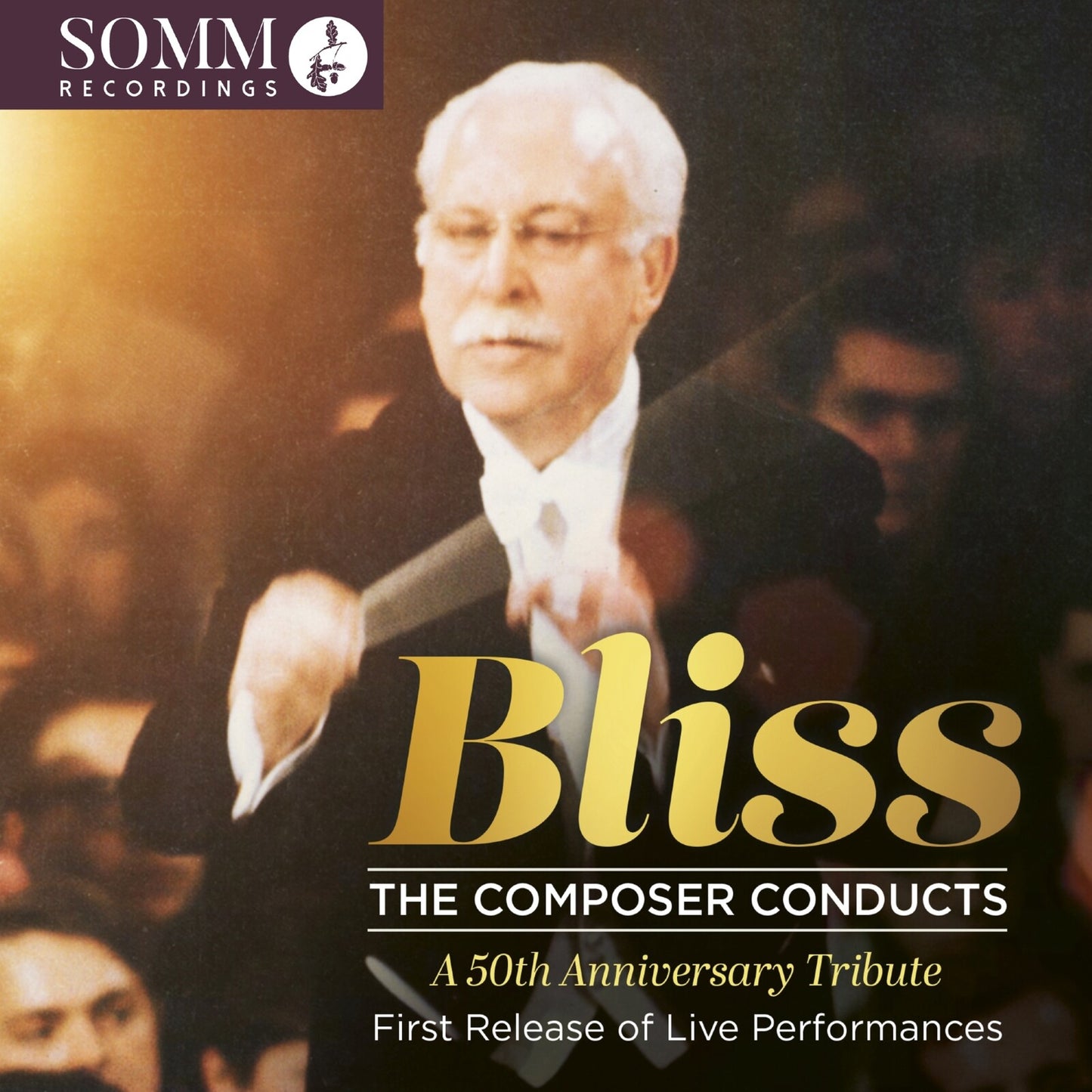
Sir Arthur Bliss (1891 - 1975) was an excellent conductor of his own music, but he sadly made only a limited number of commercial recordings. SOMM celebrates the 50th anniversary of Bliss's death with a 2-CD set of important archive performances, all but two of which he didn't record commercially, making them of particular interest. These live performances, mostly recorded at the BBC Proms and not previously made available, are skilfully remastered by long-time SOMM collaborator and executive producer, Lani Spahr. At the invitation of Edward Elgar, Bliss wrote a new work for the Three Choirs Festival in 1920. He was inspired by a book on heraldry to compose a full-scale symphony incorporating symbolic meanings associated with primary colours. Hence, the four movements of A Colour Symphony are Purple, Red, Blue, and Green. The performance issued here is with Bliss conducting his 70th birthday concert at the Proms in 1961. For his 75th birthday concert at the Proms in 1966, Bliss conducted his Piano Concerto, commissioned by the British Council in 1939. Bliss and his younger brother served during World War I, and Kennard was killed at the Battle of the Somme. In 1930, haunted by nightmares of the war and grief about his brother, Bliss composed Morning Heroes, dedicating it "to the memory of my brother Francis Kennard Bliss and all other comrades killed in battle." The work is a symphony for orator, chorus, and orchestra, with poetry ranging from The Iliad to Walt Whitman and Wilfred Owen. Lady Bliss considered the pre-eminent orator of this work to be Donald Douglas, featured here with Bliss in 1968--surprisingly, the only performance to date of Morning Heroes at the Proms. The much-revised Concerto for Two Pianos is presented in a version for two pianos and three hands, which Bliss arranged after Cyril Smith suffered a stroke that paralysed his left arm. This performance with Bliss leading Cyril Smith, Phyllis Sellick, and the BBC Symphony Orchestra is from the 1969 Proms. Two shorter works complete this Bliss anniversary tribute. Melee Fantasque from 1921, influenced by Sergei Diaghilev's Ballets Russes, is a precursor to many ballet scores Bliss would produce. The Phoenix, subtitled "Homage to France August 1944," is noted in the score as symbolizing "the imperishable life and the transcendent beauty of France." The extraordinarily vast repertoire of Dietrich Fischer-Dieskau over his 45-year career comprisedlieder, operas,cantatas,andoratorios.He sang these in German, Italian, French, Russian, English, Hebrew, Hungarian, and Latin, from eras that spanned the Baroque to the latter part of the 20th century. Particularly, it was the controlled power and beauty of his voice, and the dramatic intensity and poetry of his interpretations, that led him to excel in the genre of Germanlieder.In this form he exerted a virtually unprecedented stylistic and interpretative influence--not only on the musical world of his day, but also on generations of performers to come. SOMM's centenary tribute opens with four songs by Ferruccio Busoni, all being works that were written late in the composer's career. They come from a programme that Fischer-Dieskau gave with Gerald Moore in 1962.At the 1971 Helsinki Festival, Fischer-Dieskau presented a recital with Irwin Gage, which was devoted entirely to songs with texts by Johann Wolfgang von Goethe. The recital, described by a contemporary critic as "a landmark event," featured compositions by contemporaries of Goethe, who lived from 1749 to 1832, such as the Countess Anna Amalia, Kapellmeister Johann Friedrich Reichardt, and Goethe's friend Carl Friedrich Zelter. The more familiar composers represented on this Goethe-inspired recital were active during the first part of the 20th century. They include Richard Strauss, Max Reger, and Ferruccio Busoni. This tribute to Dietrich Fischer-Dieskau also includes six songs from a programme of works by Gustav Mahler, which was presented with his long-time collaborator, Karl Engel. Three of the songs are from Des Knaben Wunderhorn,based on texts of German folk poems, and three are from the collection of five Ruckert-Lieder,after poems written byFriedrich Ruckert. The musical component of this collection closes with a concert performance of three songs by Zoltan Kodaly, sung in Hungarian by Fischer-Dieskau. The composer proves himself an outstanding interpreter of his own music in conducting the London Symphony Orchestra. In the two interviews included on the bonus CD, Dietrich Fischer-Dieskau discusses his early years, his teachers, the development of his career, and a small but revealing cross-section of his enormous repertoire.
Details
- Genre: Classical
- Product Type: AUDIO CD
- Barcode: 758871503921
- Release Date: June 20, 2025
Delivery and Returns
Dispatch Information: Dispatch times vary by item and items are only dispatched on UK working days – not weekends or UK Bank Holidays. Items marked "Dispatched Same Day" will be dispatched on the day of purchase if bought before 2pm GMT. "Dispatched Same Day" items bought after 2pm GMT or on a non-working day will be dispatched on the next working day. For all other items the dispatch timeframe is clearly labelled on the product page.
Delivery Information: We aim to deliver your order as quickly and efficiently as possible. All UK orders are dispatched using Royal Mail 48 Tracked service and the standard delivery times are 2-3 business days. Please note that delivery times for overseas orders will vary depending on your location and the shipping option you choose during checkout.
Shipping Costs: We offer free delivery on all UK orders and free worldwide delivery on orders over £15.
Tracking Your Order: All UK orders are tracked. Once your order is dispatched, you will receive a tracking number via email. You can use this tracking number to monitor the progress of your delivery on the Royal Mail Track and Trace website.
Returns and Exchanges: We want you to be completely satisfied with your purchase. If for any reason you are not happy with your order, you may return it within 28 days of the item being dispatched for a refund or exchange. Please note the following guidelines:
- Items must be returned in their original condition and packaging – items that have been opened or had shrink wrap removed are not eligible for return or refund.
- Make sure to include your order number in the returned package.
How to Initiate a Return: To initiate a return or exchange, please contact our customer service team. The team is available to assist you with any questions or concerns you may have about the process.
Refund Processing: Refunds will be processed as soon as we receive your item back into our warehouse. Replacements are subject to availability and if a replacement is not available, a refund will be issued.
If you have any further questions or need assistance, please don't hesitate to contact our customer service team or check out our FAQ’s. We're here to help ensure your shopping experience is enjoyable and hassle-free. Thank you for choosing Chalkys!
Delivery Information: We aim to deliver your order as quickly and efficiently as possible. All UK orders are dispatched using Royal Mail 48 Tracked service and the standard delivery times are 2-3 business days. Please note that delivery times for overseas orders will vary depending on your location and the shipping option you choose during checkout.
Shipping Costs: We offer free delivery on all UK orders and free worldwide delivery on orders over £15.
Tracking Your Order: All UK orders are tracked. Once your order is dispatched, you will receive a tracking number via email. You can use this tracking number to monitor the progress of your delivery on the Royal Mail Track and Trace website.
Returns and Exchanges: We want you to be completely satisfied with your purchase. If for any reason you are not happy with your order, you may return it within 28 days of the item being dispatched for a refund or exchange. Please note the following guidelines:
- Items must be returned in their original condition and packaging – items that have been opened or had shrink wrap removed are not eligible for return or refund.
- Make sure to include your order number in the returned package.
How to Initiate a Return: To initiate a return or exchange, please contact our customer service team. The team is available to assist you with any questions or concerns you may have about the process.
Refund Processing: Refunds will be processed as soon as we receive your item back into our warehouse. Replacements are subject to availability and if a replacement is not available, a refund will be issued.
If you have any further questions or need assistance, please don't hesitate to contact our customer service team or check out our FAQ’s. We're here to help ensure your shopping experience is enjoyable and hassle-free. Thank you for choosing Chalkys!