

Description
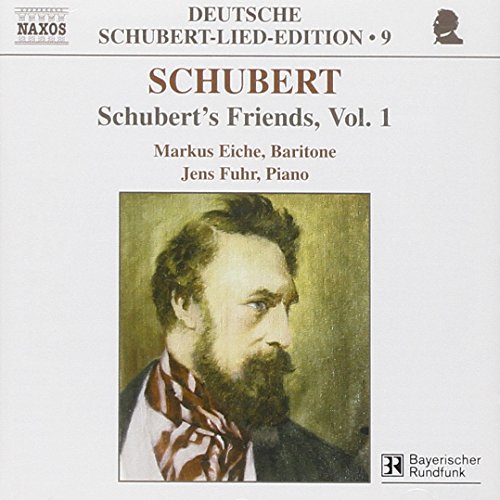
Please Note Not All Our New Items Are Shrink Wrapped.All items shipped within 3 working days of payment.Franz Peter Schubert (1797-1828)Settings of poems by Schuberts friends, Vol. 1Utopia and World-WearinessThe poetic horizon of Franz Schubert and his songs is reflected again in the poems of his circle of friends. Altogether Schubert set even more poems by his friends than he did those of Goethe or Schiller, by far the most distinguished poets. More than two thirds of these texts come from his closest friends, Johann Mayrhofer and Franz von Schober. While Mayrhofer, with about fifty settings, comes in third place after the two great classical German poets, Schober, with eighteen compositions, thirteen of them songs, stands on a par with Friedrich Schlegel, the leader of the German romantics. These quantitative comparisons are evidence of the essential quality of Schuberts poetic creed: the songs on texts by his friends combine the idealistic feeling of the classical with the Utopian longing of the romantic. The echo of a better world (besseren Welt) resounds particularly in Schobers poems, yet under conditions of pessimism. The poetry of Schuberts circle was not only under the influence of classical-romantic cultural inspiration, but showed in particular the symptoms of world-weariness spreading throughout Europe about 1820. This late romantic phenomenon, that associates the poems of the circle with those of Heinrich Heine and Wilhelm Müller, has deep roots in contemporary history. Schubert and his friends were witnesses and victims of a period of systematic suppression of idealist endeavour. After the end of the Napoleonic wars the European powers at the Congress of Vienna in 1814 and 1815 determined on the restoration of absolutist government. The Carlsbad Decrees of 1819 had finally resulted in the repression of movements towards freedom. The revolutionary ideals of liberty, equality and fraternity appeared no longer attainable. The consequent dreary reality of life plunged Schuberts generation into an existential crisis. Yet Schuberts circle of friends returned to a Tugendbund (League of Virtue), which, after the model of the poetic leagues of eighteenth-century friendship, paid homage to virtue and country in the service of a humanistic conception of man. Seminal to this circle was the Vienna Stadtkonvikt, a boarding-school for grammar-school boys, students and court chapel choristers. Schubert was at the school from 1808 until 1813 as a choirboy. Schober too, with whom Schubert later lived together for several years, had, while a student at Vienna University, moved in the same milieu. Schubert gathered there not only a practical knowledge of musical performance and of repertoire, but in productive exchange with his friends also acquired a literary stimulus towards the composition of songs. The creative relations with amateurs of the arts and cultivated men such as Josef von Spaun, Josef Kenner, Johann Senn or Albert Stadler enabled Schubert in this elite institution, in which he seemed
Schatzgrabers Begehr, D761
Jagers Liebeslied, D909
Genugsamkeit, D143
Der Strom, D565
Grablied, D218
Der Liedler, D209
Ballade (Ein Fraulein schaut vom hohen Turm), D134
Der Vater mit dem Kind, D909
Der Jungling und der Tod (2nd Version), D545
Pax Vobiscum, D551
Schiffers Scheidelied, D910
Pilgerweise, D789
Am Bach im Fruhling, D361
An die Musik, D547
An die Leier, D737
Der zurnende Barde, D785
Details
- Genre: Classical
- Product Type: AUDIO CD
- Barcode: 636943479926
Delivery and Returns
Dispatch Information: Dispatch times vary by item and items are only dispatched on UK working days – not weekends or UK Bank Holidays. Items marked "Dispatched Same Day" will be dispatched on the day of purchase if bought before 2pm GMT. "Dispatched Same Day" items bought after 2pm GMT or on a non-working day will be dispatched on the next working day. For all other items the dispatch timeframe is clearly labelled on the product page.
Delivery Information: We aim to deliver your order as quickly and efficiently as possible. All UK orders are dispatched using Royal Mail 48 Tracked service and the standard delivery times are 2-3 business days. Please note that delivery times for overseas orders will vary depending on your location and the shipping option you choose during checkout.
Shipping Costs: We offer free delivery on all UK orders and free worldwide delivery on orders over £15.
Tracking Your Order: All UK orders are tracked. Once your order is dispatched, you will receive a tracking number via email. You can use this tracking number to monitor the progress of your delivery on the Royal Mail Track and Trace website.
Returns and Exchanges: We want you to be completely satisfied with your purchase. If for any reason you are not happy with your order, you may return it within 28 days of the item being dispatched for a refund or exchange. Please note the following guidelines:
- Items must be returned in their original condition and packaging – items that have been opened or had shrink wrap removed are not eligible for return or refund.
- Make sure to include your order number in the returned package.
How to Initiate a Return: To initiate a return or exchange, please contact our customer service team. The team is available to assist you with any questions or concerns you may have about the process.
Refund Processing: Refunds will be processed as soon as we receive your item back into our warehouse. Replacements are subject to availability and if a replacement is not available, a refund will be issued.
If you have any further questions or need assistance, please don't hesitate to contact our customer service team or check out our FAQ’s. We're here to help ensure your shopping experience is enjoyable and hassle-free. Thank you for choosing Chalkys!
Delivery Information: We aim to deliver your order as quickly and efficiently as possible. All UK orders are dispatched using Royal Mail 48 Tracked service and the standard delivery times are 2-3 business days. Please note that delivery times for overseas orders will vary depending on your location and the shipping option you choose during checkout.
Shipping Costs: We offer free delivery on all UK orders and free worldwide delivery on orders over £15.
Tracking Your Order: All UK orders are tracked. Once your order is dispatched, you will receive a tracking number via email. You can use this tracking number to monitor the progress of your delivery on the Royal Mail Track and Trace website.
Returns and Exchanges: We want you to be completely satisfied with your purchase. If for any reason you are not happy with your order, you may return it within 28 days of the item being dispatched for a refund or exchange. Please note the following guidelines:
- Items must be returned in their original condition and packaging – items that have been opened or had shrink wrap removed are not eligible for return or refund.
- Make sure to include your order number in the returned package.
How to Initiate a Return: To initiate a return or exchange, please contact our customer service team. The team is available to assist you with any questions or concerns you may have about the process.
Refund Processing: Refunds will be processed as soon as we receive your item back into our warehouse. Replacements are subject to availability and if a replacement is not available, a refund will be issued.
If you have any further questions or need assistance, please don't hesitate to contact our customer service team or check out our FAQ’s. We're here to help ensure your shopping experience is enjoyable and hassle-free. Thank you for choosing Chalkys!