

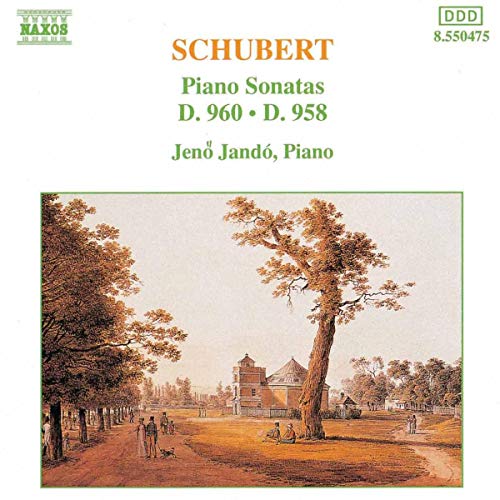
Description
Please Note Not All Our New Items Are Shrink Wrapped.All items shipped within 3 working days of payment.Franz Schubert (1797 - 1828) Sonata in C Minor, D. 958 Sonata in B Flat Major, D. 960 Franz Schubert was born in Vienna in 1797, the son of aschool-master, whose path it seemed he might follow as an assistant teacher. He enjoyed asound musical training as a cathedral chorister and when his voice broke in 1812 rejectedthe offered scholarship and further general education in favour of a career that allowedhim more time for music. In 1814 he embarked on a course as a primary school teacher andthe following year joined his father, although he showed no great aptitude for his newprofession, which he was to practise intermittently, as need arose, for a year or so. Thegreater part of the remaining years of his life were devoted to music and to the companyof his friends. By the time of his death in 1828 some of his music had been published andthere was increasing interest in his compositions. Nevertheless he never held any officialposition in the musical establishment in Vienna and much of what he wrote was intended forthe entertainment of his own circle, which included bath professional and amateurmusicians, poets and painters.The death of Beethoven in 1827 seems to have suggested toSchubert the possibility that he might become his musical successor. This ambition,whether overt or not, found some immediate expression in the three piano sonatas of 1828,completed in September, some six weeks before his own death. Schubert proposed adedication to Hummel, a pupil of Mozart, leading pianist and successful composer, whom hehad met in 1827. When the sonatas were finally published, posthumously, the dedication bythe publisher was to Robert Schumann, who did much to bring the music of Schubert topublic notice in the second quarter of the 19th century. Schubert played all three sonatason 27th September at a party at the house of Dr. Ignaz Menz. The Sonata in C minor, D.958, opens with a heroic figure that Beethoven might have used. There is agentler second subject in the expected key of E flat major, and a central development thatstarts dramatically enough, before moving into a much gentler mood which neverthelessexplores the wider range of the contemporary piano. The A fiat major Adagio is daring inits harmonic imagination, a sign of things to come. It is followed by a C minor Minuetwith an A fiat major Trio. The final rondo has the vigour and energy of a tarantella, itsheadlong rhythm interrupted by contrasting episodes. The last of the 1828 sonatas, the Sonata in B flat major, D. 960, opens in a mannercharacteristic of many of Schubert's songs and its gentle first theme dominates theextended movement. The slow movement, moving from C sharp minor to A major and to a finalC sharp major has about it a beautiful serenity and is followed by a delicately gracefulscherzo in B fiat major, framing a solemn Trio in the tonic minor key. The final rondostarts in harmonic ambiguity, suggesting the influence of Beethoven's substituted finalmovement for his Opus 130 String Q
Molto Moderato
Andante Sostenuto
Scherzo: Allegro Vivace Con Delicatezza
Allegro Ma Non Troppo
Allegro
Adagio
Menuetto: Allegro
Allegro
Track Listing
Molto Moderato
Andante Sostenuto
Scherzo: Allegro Vivace Con Delicatezza
Allegro Ma Non Troppo
Allegro
Adagio
Menuetto: Allegro
Allegro
Details
- Genre: Classical
- Product Type: AUDIO CD
- Barcode: 4891030504752
Delivery and Returns
Dispatch Information: Dispatch times vary by item and items are only dispatched on UK working days – not weekends or UK Bank Holidays. Items marked "Dispatched Same Day" will be dispatched on the day of purchase if bought before 2pm GMT. "Dispatched Same Day" items bought after 2pm GMT or on a non-working day will be dispatched on the next working day. For all other items the dispatch timeframe is clearly labelled on the product page.
Delivery Information: We aim to deliver your order as quickly and efficiently as possible. All UK orders are dispatched using Royal Mail 48 Tracked service and the standard delivery times are 2-3 business days. Please note that delivery times for overseas orders will vary depending on your location and the shipping option you choose during checkout.
Shipping Costs: We offer free delivery on all UK orders and free worldwide delivery on orders over £15.
Tracking Your Order: All UK orders are tracked. Once your order is dispatched, you will receive a tracking number via email. You can use this tracking number to monitor the progress of your delivery on the Royal Mail Track and Trace website.
Returns and Exchanges: We want you to be completely satisfied with your purchase. If for any reason you are not happy with your order, you may return it within 28 days of the item being dispatched for a refund or exchange. Please note the following guidelines:
- Items must be returned in their original condition and packaging – items that have been opened or had shrink wrap removed are not eligible for return or refund.
- Make sure to include your order number in the returned package.
How to Initiate a Return: To initiate a return or exchange, please contact our customer service team. The team is available to assist you with any questions or concerns you may have about the process.
Refund Processing: Refunds will be processed as soon as we receive your item back into our warehouse. Replacements are subject to availability and if a replacement is not available, a refund will be issued.
If you have any further questions or need assistance, please don't hesitate to contact our customer service team or check out our FAQ’s. We're here to help ensure your shopping experience is enjoyable and hassle-free. Thank you for choosing Chalkys!
Delivery Information: We aim to deliver your order as quickly and efficiently as possible. All UK orders are dispatched using Royal Mail 48 Tracked service and the standard delivery times are 2-3 business days. Please note that delivery times for overseas orders will vary depending on your location and the shipping option you choose during checkout.
Shipping Costs: We offer free delivery on all UK orders and free worldwide delivery on orders over £15.
Tracking Your Order: All UK orders are tracked. Once your order is dispatched, you will receive a tracking number via email. You can use this tracking number to monitor the progress of your delivery on the Royal Mail Track and Trace website.
Returns and Exchanges: We want you to be completely satisfied with your purchase. If for any reason you are not happy with your order, you may return it within 28 days of the item being dispatched for a refund or exchange. Please note the following guidelines:
- Items must be returned in their original condition and packaging – items that have been opened or had shrink wrap removed are not eligible for return or refund.
- Make sure to include your order number in the returned package.
How to Initiate a Return: To initiate a return or exchange, please contact our customer service team. The team is available to assist you with any questions or concerns you may have about the process.
Refund Processing: Refunds will be processed as soon as we receive your item back into our warehouse. Replacements are subject to availability and if a replacement is not available, a refund will be issued.
If you have any further questions or need assistance, please don't hesitate to contact our customer service team or check out our FAQ’s. We're here to help ensure your shopping experience is enjoyable and hassle-free. Thank you for choosing Chalkys!