

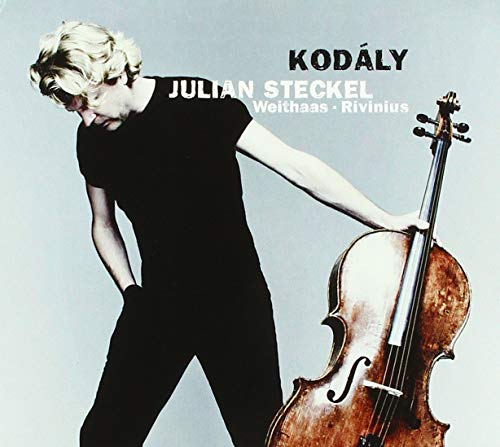
Description
Kodxe1ly's Sonata for Solo Cello is a major hurdle in the cello solo repertoire. Returning to the recording studio after 5 years, Julian Steckel tackles this difficult work alongside other chamber pieces by Kodaly together with pianist Paul Rivinius and Antje Weithaas.r r
'The piece is unlike no other of its kind', Bxe9la Bartxf3k affirmed: 'the world of ideas it contains is entirely new'. Timbre acquired an unusual, novel dimension by having the two lowest strings tuned one half-step down, to B and F, respectively. Thus the three lower strings form a B Minor chord, which Kodxe1ly places in particular prominence at the onset of the sonata,rr
Julian Steckel was inspired to tackle this 'Everest of cello literature' for the first time at the age of fifteen. The technical challenge was certainly exciting in itself, but he was also fascinated by the music's beauty, and by Kodxe1ly's special musical language u2013 'even though at that time I didn't yet know what was Hungarian about it, or what came from Debussy or other sources', he remarks. Steckel proceeded to work on the sonata with several cellists including the venerable Hungarian-American legend Janxf3s Starker. He studied the work's historical background: 'When you know where a certain music is coming from, it reinforces the sort of telepathic connection you feel with the audience, and you end up playing much more convincingly'. Janxf3s Starker, for one, insisted that 'all the beginnings, including those in the slow movements, are consonant. You should never play as if you were murmuring. In this music, none of the beautiful cantilenas ever emerge out of nothing. You must always remain entirely clear in your expression and in the way you produce the sound. The fact that the music is rhapsodic should not entice you to start playing freely all the time. Precise rhythm is of utter importance. Otherwise you would be fishing in troubled waters, and the music would become a sort of goulash soup.'rr
The same applies to the Duo for Violin and Cello, op. 7. Kodxe1ly wrote it in 1914, at the onset of World War I, just before the solo cello sonata. At that time he and his wife were in Switzerland. 'We had to spend several days in a village on the border to Tyrol. That is where I was suddenly seized by a vision of this duo in my mind', he wrote in 1924. 'It remains to be seen whether others can sense something of the indescribable greatness of the mountains, or, rather, the dark premonition of impending war in this work.'rrCRITICAL ACCLAIMr'A rewarding account...this is music that soars' - BBC Music Magazine ****/****
Kodaly: Sonatina for Cello and Piano, Op. 4
Kodaly: Sonata for Cello Solo, Op. 8 (1915)I. Allegro maestoso ma appassionato
Kodaly: Sonata for Cello Solo, Op. 8 (1915)II. Adagio (con gran espressione)
Kodaly: Sonata for Cello Solo, Op. 8 (1915)III. Allegro molto vivace
Kodaly: Duo for Cello and Violin, Op. 7 (1914) I
Kodaly: Duo for Cello and Violin, Op. 7 (1914) II
Kodaly: Duo for Cello and Violin, Op. 7 (1914) III
Track Listing
Kodaly: Sonatina for Cello and Piano, Op. 4
Kodaly: Sonata for Cello Solo, Op. 8 (1915)I. Allegro maestoso ma appassionato
Kodaly: Sonata for Cello Solo, Op. 8 (1915)II. Adagio (con gran espressione)
Kodaly: Sonata for Cello Solo, Op. 8 (1915)III. Allegro molto vivace
Kodaly: Duo for Cello and Violin, Op. 7 (1914) I
Kodaly: Duo for Cello and Violin, Op. 7 (1914) II
Kodaly: Duo for Cello and Violin, Op. 7 (1914) III
Details
- Genre: Classical
- Product Type: AUDIO CD
- Barcode: 4260085532728
Delivery and Returns
Delivery Information: We aim to deliver your order as quickly and efficiently as possible. All UK orders are dispatched using Royal Mail 48 Tracked service and the standard delivery times are 2-3 business days. Please note that delivery times for overseas orders will vary depending on your location and the shipping option you choose during checkout.
Shipping Costs: We offer free delivery on all UK orders and free worldwide delivery on orders over £15.
Tracking Your Order: All UK orders are tracked. Once your order is dispatched, you will receive a tracking number via email. You can use this tracking number to monitor the progress of your delivery on the Royal Mail Track and Trace website.
Returns and Exchanges: We want you to be completely satisfied with your purchase. If for any reason you are not happy with your order, you may return it within 28 days of the item being dispatched for a refund or exchange. Please note the following guidelines:
- Items must be returned in their original condition and packaging – items that have been opened or had shrink wrap removed are not eligible for return or refund.
- Make sure to include your order number in the returned package.
How to Initiate a Return: To initiate a return or exchange, please contact our customer service team. The team is available to assist you with any questions or concerns you may have about the process.
Refund Processing: Refunds will be processed as soon as we receive your item back into our warehouse. Replacements are subject to availability and if a replacement is not available, a refund will be issued.
If you have any further questions or need assistance, please don't hesitate to contact our customer service team or check out our FAQ’s. We're here to help ensure your shopping experience is enjoyable and hassle-free. Thank you for choosing Chalkys!