

Description
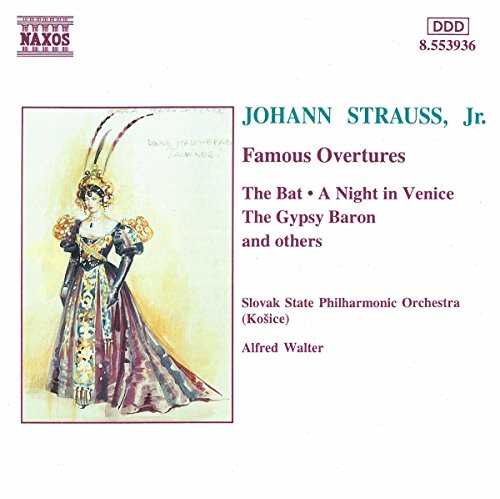
Please Note Not All Our New Items Are Shrink Wrapped.All items shipped within 3 working days of payment.Johann Strauss, Jr.(1825- 1899) Famous OverturesThe younger JohannStrauss was the son of the founder of the musical dynasty, a musician of thesame name who had established his own dance orchestra in Vienna in 1825, theyear of his eldest son's birth. The older Johann Strauss, a prolific composerof dance music, had intended very different careers for his three sons. In theevent all three became involved in the activities of the dance-orchestrasestablished by the younger Johann Strauss, the Waltz-King, whose career spannedthe second half of the nineteenth century.Strauss was relativelylate in turning his attention to operetta. Offenbach, the dominant composer inoperetta in Paris, had made the suggestion to him, but it was at the urging ofhis first wife Jetty, the singer Henriette Chalupetzky, that he made his firstattempt at the genre, Indigo und die vierzig Rauber ('Indigo and theForty Thieves'), staged at the Theater an der Wien on 10th February 1871 and asuccess in spite of its libretto, described by Eduard Hanslick as Straussdance-music with words added. The score proved the source of a number of purelyinstrumental works, in addition to the lively overture.The second Straussoperetta, Karneval in Rom ('Carnival in Rome') was staged in 1873,followed in 1874 by the most famous and lasting of all operettas, DieFledermaus ('The Bat'), its libretto derived from a French version of anearlier German comedy. The overture makes use of some of the principal elementsin the score, striking in its very opening, based on the third act Trio betweenEisenstein, his wife Rosalinde and her lover Alfred, other parts of which areused in a sparkling texture that sets the mood for the light-hearted drama thatfollows, with its mistaken identities, flirtations and deceptions.The fourth of theStrauss operettas, Cagliostro in Wien ('Cagliostro in Vienna'), wasfirst staged on 27th February 1875 and based on escapades in the life of theeighteenth century Italian alchemist, magician and adventurer. Once again themusic was an immediate success, winning, in particular, the praise of Brahms, acomposer of a very different kind.Prinz Methusalem ('Prince Methusaleh') was first performed on3rd January 1877 and achieved a very respectable run of eighty performances.The overture, which later found a place in concerts offered under JohannStrauss's youngest brother, Eduard, makes use of themes from the operetta, withadditional material that may at one time have been part of the planned score.It combines martial elements with dance-tunes and ends with an effectiveclimax. The next operetta was Blindekuh ('Blind Man's Buff'), mounted atthe Theater an der Wien on 18th December 1878, its composition delayed by thedeath of Strauss's wife Jetty and his immediate marriage to the young AngelikaDiettrich, thirty years his junior. The overture was given an earlierperformance at a charity event, described by a critic as a game of blind man'sbuff between a teasing polka and a roguish waltz. The oper
The Bat
A Night in Venice
Indigo And Forty Thieves
Cagliostro in Vienna
Prince Methusaleh
Blind Man's Buff
The Queen's Lace Handkerchief
Woodruff
The Gypsy Baron
Details
- Genre: Classical
- Product Type: AUDIO CD
- Barcode: 730099493628
Delivery and Returns
Dispatch Information: Dispatch times vary by item and items are only dispatched on UK working days – not weekends or UK Bank Holidays. Items marked "Dispatched Same Day" will be dispatched on the day of purchase if bought before 2pm GMT. "Dispatched Same Day" items bought after 2pm GMT or on a non-working day will be dispatched on the next working day. For all other items the dispatch timeframe is clearly labelled on the product page.
Delivery Information: We aim to deliver your order as quickly and efficiently as possible. All UK orders are dispatched using Royal Mail 48 Tracked service and the standard delivery times are 2-3 business days. Please note that delivery times for overseas orders will vary depending on your location and the shipping option you choose during checkout.
Shipping Costs: We offer free delivery on all UK orders and free worldwide delivery on orders over £15.
Tracking Your Order: All UK orders are tracked. Once your order is dispatched, you will receive a tracking number via email. You can use this tracking number to monitor the progress of your delivery on the Royal Mail Track and Trace website.
Returns and Exchanges: We want you to be completely satisfied with your purchase. If for any reason you are not happy with your order, you may return it within 28 days of the item being dispatched for a refund or exchange. Please note the following guidelines:
- Items must be returned in their original condition and packaging – items that have been opened or had shrink wrap removed are not eligible for return or refund.
- Make sure to include your order number in the returned package.
How to Initiate a Return: To initiate a return or exchange, please contact our customer service team. The team is available to assist you with any questions or concerns you may have about the process.
Refund Processing: Refunds will be processed as soon as we receive your item back into our warehouse. Replacements are subject to availability and if a replacement is not available, a refund will be issued.
If you have any further questions or need assistance, please don't hesitate to contact our customer service team or check out our FAQ’s. We're here to help ensure your shopping experience is enjoyable and hassle-free. Thank you for choosing Chalkys!
Delivery Information: We aim to deliver your order as quickly and efficiently as possible. All UK orders are dispatched using Royal Mail 48 Tracked service and the standard delivery times are 2-3 business days. Please note that delivery times for overseas orders will vary depending on your location and the shipping option you choose during checkout.
Shipping Costs: We offer free delivery on all UK orders and free worldwide delivery on orders over £15.
Tracking Your Order: All UK orders are tracked. Once your order is dispatched, you will receive a tracking number via email. You can use this tracking number to monitor the progress of your delivery on the Royal Mail Track and Trace website.
Returns and Exchanges: We want you to be completely satisfied with your purchase. If for any reason you are not happy with your order, you may return it within 28 days of the item being dispatched for a refund or exchange. Please note the following guidelines:
- Items must be returned in their original condition and packaging – items that have been opened or had shrink wrap removed are not eligible for return or refund.
- Make sure to include your order number in the returned package.
How to Initiate a Return: To initiate a return or exchange, please contact our customer service team. The team is available to assist you with any questions or concerns you may have about the process.
Refund Processing: Refunds will be processed as soon as we receive your item back into our warehouse. Replacements are subject to availability and if a replacement is not available, a refund will be issued.
If you have any further questions or need assistance, please don't hesitate to contact our customer service team or check out our FAQ’s. We're here to help ensure your shopping experience is enjoyable and hassle-free. Thank you for choosing Chalkys!